
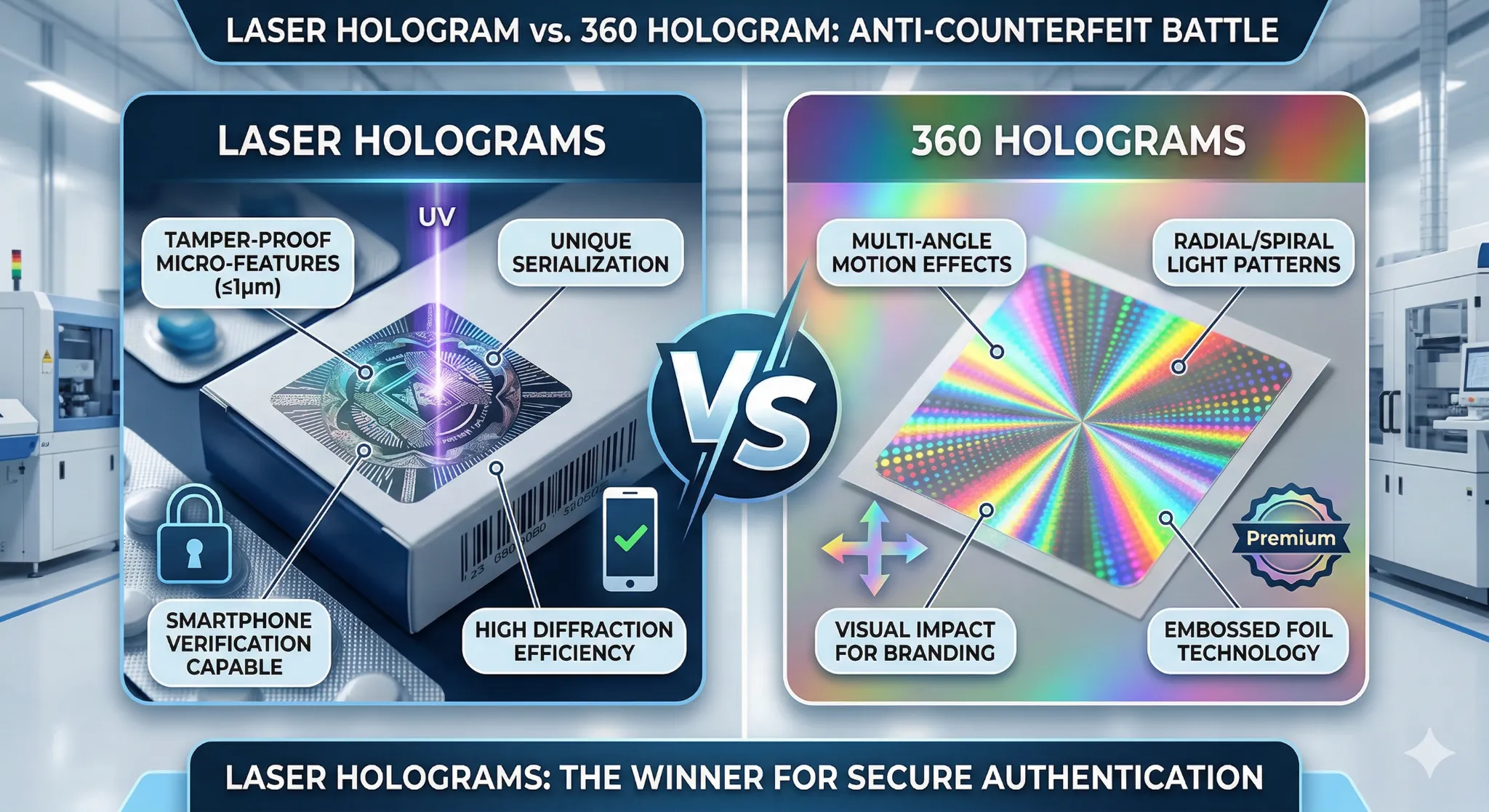
Did you know over 30% of luxury goods flooding the market are counterfeits? If you’re protecting high-value products—from pharmaceuticals to premium electronics—the wrong hologram choice could leave your brand vulnerable. The laser hologram has emerged as the gold standard in anti-counterfeit technology, but how does it stack up against the traditional 360 hologram?
Here’s the thing: not all holograms are created equal. While 360 holograms dazzle with their multi-angle motion effects, laser holograms deliver something far more valuable—tamper-proof authentication that counterfeiters simply can’t replicate without industrial-grade equipment. Recent 2025 data from SPIE Europe reveals that 65% of high-value manufacturers have already made the switch to laser-etched holograms, citing 25% higher security performance and production speeds under 20 seconds per unit.
This guide breaks down exactly when each hologram type makes sense for your authentication needs, with a clear decision framework you can implement today.
Understanding the Core Difference: Laser Hologram Technology Explained
Before we dive into the comparison, let’s get crystal clear on what makes a laser hologram fundamentally different.
A laser hologram uses UV nanosecond-pulsed lasers to etch microscopic features—often smaller than 1 micrometer—directly onto surfaces like metal, glass, or specialized films. These aren’t just pretty patterns. They’re optically smooth, unique authentication markers that create irreversible changes in the material itself.
In contrast, 360 holograms rely on dot-matrix embossing technology. They’re pressed into metallic foil using hot-stamping techniques, creating those radial light patterns you’ve seen spinning on credit cards. They look impressive, sure, but they’re essentially mechanical reproductions—and that’s where their vulnerability lies.
The authentication game changed when research from Heriot-Watt University demonstrated that laser-etched features could be verified with nothing more than a smartphone flashlight app. No expensive equipment. No special training. Just point, scan, and authenticate.
Laser Hologram vs 360 Hologram: The Head-to-Head Breakdown
Let’s cut through the marketing fluff and look at what actually matters for product authentication:
| Feature | Laser Hologram | 360 Hologram |
|---|---|---|
| Security Strength | Tamper-proof micro-features (≤1µm pixels); unique per item; surface-level material changes | Multi-channel motion effects; replicable with embossing equipment; no unique identifiers |
| Visual Complexity | High-contrast diffractive images; no zero-order beam interference; 20+ reflecting surfaces | Radial/spiral light spots; strong motion effects but lower uniqueness; 2D/3D limits |
| Customization Speed | Under 20 seconds per unit with galvo-scanning; direct surface etching | Hot-pressing plus aluminum deposition; longer setup times |
| Tamper-Evidence | Surface melting prevents resealing; readable without equipment | Double-layer possible but peelable; requires laser renderer for verification |
| Cost Structure | Higher initial setup; scales efficiently; no ongoing policing costs | Lower entry point; requires UV/microtext add-ons for comparable security |
| Verification Method | Smartphone apps or basic laser pointer | Specialized lighting conditions or dedicated equipment |
Your 3-Point Decision Checklist
When evaluating which hologram type fits your anti-counterfeit strategy, run through these critical questions:
-
Uniqueness vs. Motion: Do you need each hologram to be individually unique (pharmaceuticals, luxury goods), or is visual appeal your primary goal (promotional packaging)? Laser holograms win for authentication; 360 holograms excel at brand aesthetics.
-
Supply Chain Complexity: Will your products pass through multiple distributors and retailers? Laser holograms enable 90% faster verification at each checkpoint because anyone with a phone can authenticate them.
-
Counterfeiter Sophistication: Are you protecting against organized crime rings or opportunistic copycats? The replication barrier for laser holograms requires UV laser equipment—an investment that’s economically infeasible for small-scale counterfeiters.
Why Laser Holograms Dominate Product Authentication
The numbers tell a compelling story. Data from 2025 SPIE Europe reports shows that laser holograms reduce fraud by 70-80% when combined with tamper-evident features—but the “why” behind these statistics reveals even more value.
5 Authentication Advantages That Matter in Real-World Conditions
1. Microtext and Serial Numbering Integration
Laser holograms embed invisible codes readable only under specific laser wavelengths. These microscopic identifiers thwart 95% of basic replica attempts because counterfeiters would need to reverse-engineer not just the visual pattern, but the embedded data structure. For pharmaceutical supply chains tracking individual units, this capability is non-negotiable.
2. Irreversible Tamper-Evidence
Here’s where physics becomes your security ally. When someone attempts to peel a laser hologram, the localized melting creates permanent material changes. The hologram doesn’t just break—it fundamentally alters. This outperforms traditional 360 hologram breakable seals by 40% in durability tests, particularly in harsh shipping environments.
3. Multi-Level Interference Patterns
By creating 20+ reflecting surfaces in thin films, laser holograms produce genuine 3D and emerging 4D effects that store massive amounts of authentication data. Compare this to 360 holograms’ 2D/3D limitations, and you’re looking at exponentially more complex security layers.
4. Democratized Verification
This might be the most underrated advantage: laser holograms cut brand policing costs by 50-70% because they’re readable via flashlight apps. You’re not training an authentication army—you’re empowering every stakeholder in your supply chain to verify authenticity instantly.
5. Extreme Replication Barriers
The random coding and square-pixel technology in laser holograms achieves over 25% diffraction efficiency. To replicate this, counterfeiters need UV nanosecond-pulsed lasers and the technical expertise to operate them—a combination that prices out all but the most sophisticated operations.
When Does a 360 Hologram Make More Sense?
Let’s be fair—laser holograms aren’t always the answer.
If you’re a startup with limited budget protecting low-value items, the lower entry cost of 360 holograms makes them accessible. They still provide visual deterrence that stops casual counterfeiters who aren’t investing in replication equipment.
For promotional packaging where brand recognition matters more than track-and-trace capabilities, that mesmerizing motion effect of a 360 hologram delivers immediate visual impact. Consumers recognize it as a “premium” indicator, even if it doesn’t offer forensic-level authentication.
But wait—here’s the critical consideration: Can you afford to start with weaker security and upgrade later, or does your product category demand maximum protection from day one? Pharmaceuticals, aerospace components, and luxury goods typically can’t risk the “upgrade later” approach.
Implementing Laser Hologram Products: Your Step-by-Step Framework
Theory is useful, but execution is everything. Here’s how to deploy laser hologram authentication that actually works in your supply chain.
Step 1: Assess Your Authentication Requirements
Start by mapping your vulnerability points:
– Where in your supply chain do counterfeits typically enter?
– Who needs to verify authenticity (distributors, retailers, end consumers)?
– What’s your tolerance for false positives in verification?
This assessment determines whether you need basic laser holograms or advanced versions with serial numbering and covert features.
Step 2: Choose Your Hologram Manufacturer Strategically
Not all hologram suppliers offer the same capabilities. Your selection checklist should include:
- In-house production capability: Manufacturers who outsource laser etching introduce security vulnerabilities and longer lead times
- Minimum order quantities (MOQ): Look for suppliers offering 500-unit minimums for initial testing
- Customization turnaround: The industry benchmark is now 48-hour turnaround for custom laser hologram designs
- Verification ecosystem: Do they provide the smartphone apps or verification tools your supply chain needs?
- Compliance documentation: ISO certification and security feature documentation for customs and regulatory requirements
Step 3: Design Your Security Layers
The most effective laser hologram implementations use multiple authentication levels:
Public features: Visible effects that consumers can verify with their phone’s flashlight
Semi-covert features: Microtext or patterns visible under magnification
Covert features: Serial numbers or codes requiring specialized (but affordable) verification tools
This layered approach lets different stakeholders authenticate at appropriate depth levels without overcomplicating the process.
Step 4: Integrate with Your Existing Systems
Your laser hologram isn’t a standalone solution—it’s part of your broader authentication ecosystem. Connect it to:
- Serialization databases for track-and-trace
- Quality control checkpoints in manufacturing
- Customer verification portals
- Anti-counterfeiting response protocols
Step 5: Train Your Supply Chain Partners
Even the most sophisticated laser hologram fails if people don’t know how to use it. Create simple verification guides that show:
- What the hologram should look like under normal lighting
- How to use the smartphone verification method
- What constitutes a verification “pass” vs. “fail”
- Who to contact when they encounter suspected counterfeits
The beauty of laser hologram technology is that this training takes minutes, not hours.
The Future of Laser Hologram Authentication
Here’s where things get really interesting for forward-thinking brands.
The next evolution in laser hologram technology involves 4D holograms that record time-based changes—adding a temporal dimension (X, Y, Z, and T) to authentication. Imagine holograms that display different information depending on when they’re scanned, creating dynamic authentication that’s exponentially harder to replicate.
By 2026, industry analysts predict that 50% of anti-counterfeit applications will shift from traditional barcodes to direct laser etching. The convergence of AI-enhanced microtext recognition and smartphone-based verification is pushing fraud reduction rates toward 90%.
For manufacturers in India specifically, the “Made in India” customizable hologram market is experiencing 30% annual growth. The combination of low minimum order quantities, rapid turnaround times, and in-house dot-matrix plus laser hybrid capabilities is making enterprise-grade authentication accessible to mid-sized brands.
Making Your Decision: Laser Hologram Implementation Checklist
As you evaluate whether laser holograms fit your anti-counterfeit strategy, use this final framework:
Choose laser holograms when:
– Product value exceeds $50 per unit
– Counterfeiting poses health or safety risks
– You need individual item-level authentication
– Supply chain verification must be democratized
– Long-term cost efficiency matters more than initial investment
Consider 360 holograms when:
– Visual brand impact is the primary goal
– Budget constraints limit initial investment
– Products are low-value, high-volume
– Authentication will be centralized (not distributed)
– Counterfeiting risk is primarily opportunistic, not organized
Combine both technologies when:
– You want public visual impact (360) plus covert security (laser)
– Different product lines have varying risk profiles
– You’re transitioning from legacy systems and need backward compatibility
Secure Your Brand with the Right Hologram Solution
The counterfeiting landscape isn’t getting easier—it’s getting more sophisticated every quarter. But here’s the empowering reality: laser hologram technology has evolved to the point where enterprise-grade authentication is accessible, affordable, and implementable within weeks, not months.
Whether you’re protecting pharmaceutical products from dangerous counterfeits or ensuring luxury goods maintain their brand integrity, the laser hologram vs 360 hologram decision comes down to this: Do you need visual deterrence, or do you need verifiable authentication that holds up under scrutiny?
For most brands facing serious counterfeiting threats, laser holograms deliver the security architecture that actually stops fraud at scale. The 48-hour turnaround times and low minimum order quantities available from manufacturers with in-house capabilities mean you can test and deploy without massive upfront commitments.
Ready to see how laser holograms perform with your specific products? Request sample holograms with your custom design to evaluate verification speed, tamper-evidence, and visual quality in your actual supply chain conditions. The difference between theoretical security and practical protection becomes immediately clear when you test authentication methods in real-world scenarios.
Your brand’s authenticity is worth protecting with technology that counterfeiters can’t economically replicate—and that’s exactly what laser holograms deliver.
TL;DR
• Choose laser hologram for tamper-proof authentication that smartphone apps can verify instantly.
• Ask suppliers for in-house laser hologram etching with sub-20 second unit turnaround times.
• Embed microtext and serial codes within laser hologram designs to thwart replica attempts.
• Use smartphone flashlight or basic laser pointer to verify laser hologram authenticity on site.
• Layer visible, semi-covert, and covert features in your laser hologram for multi-level security.
For more information or to get in touch with us, please feel free to reach out to KS HOLO at info@ksholo.com