
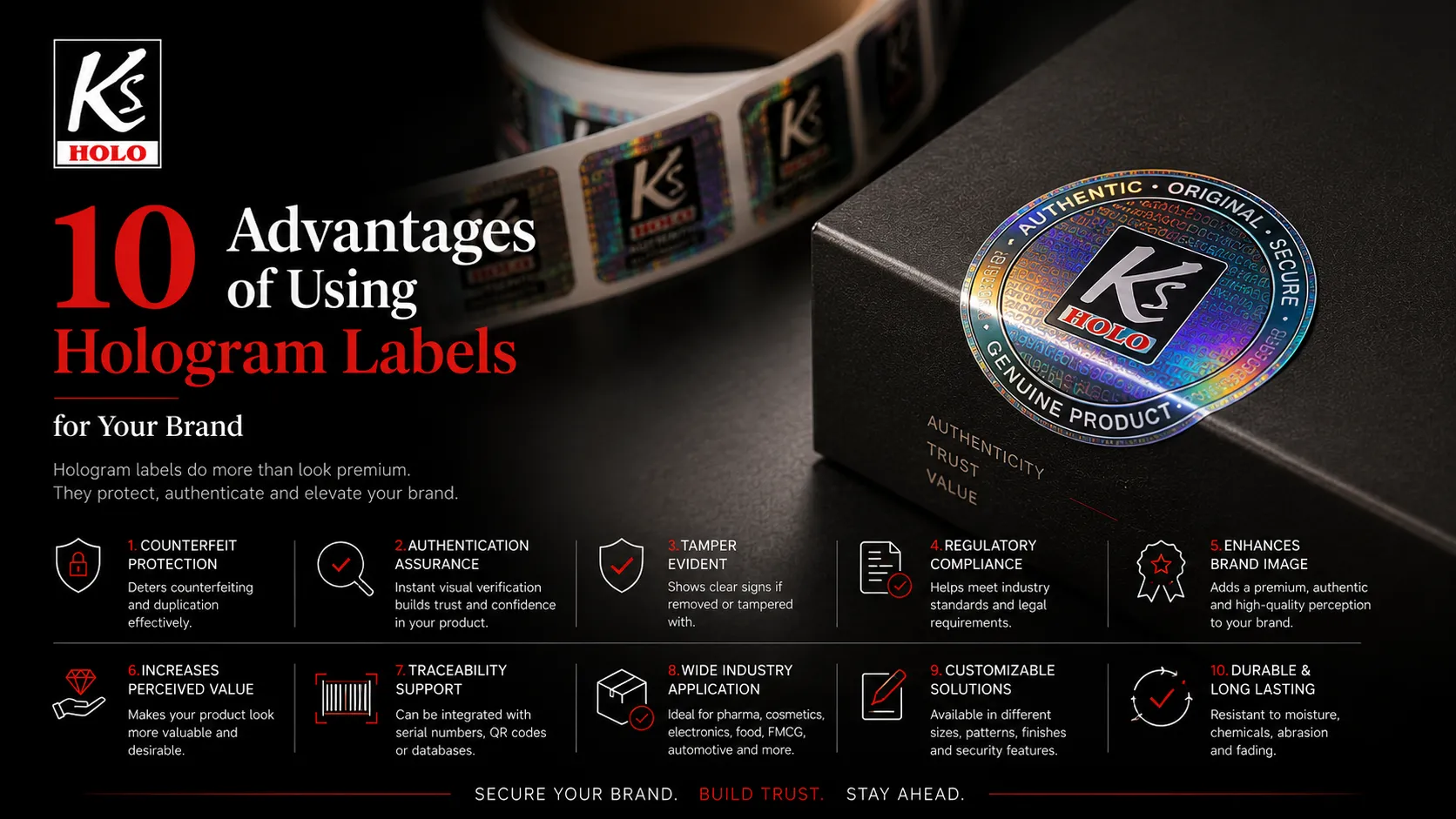
10 Advantages of Using Hologram Labels for Your Brand
According to the State of Counterfeiting in India 2025 report by ASPA and Crisil Intelligence, 89% of urban Indian consumers have purchased a fake product at least once — and 35% encountered counterfeit goods in the last year alone. For brand owners, every counterfeit product in the market is both a direct revenue loss and a compounding reputational liability. The advantages of hologram labels go far beyond a visual effect — they represent a physical, legal, and commercial defence that no standard printed label can replicate. This article details all ten of them.
What Makes Hologram Labels Different from Ordinary Security Labels?
A hologram label is not simply a shiny sticker. It is a multi-layer security device manufactured using laser interference and precision metallic film. The visible colour-shift effect — produced by a diffraction grating etched at nanometre precision — cannot be reproduced by any standard offset, digital, or inkjet printer. This single property is what separates holographic labels from every other form of product authentication available at comparable cost.
Most printed security labels — barcodes, serial numbers, colour-shifting inks — can be copied given sufficient equipment and intent. A genuine ASPA-certified hologram sticker requires a master recording, controlled production conditions, and specialised equipment that counterfeiters cannot access economically. This cost and complexity barrier is the foundation on which all other hologram label advantages rest.
Can a QR code replace a hologram label for brand protection?
A QR code alone cannot replace a hologram label because it provides digital traceability but no physical tamper evidence. A QR code can be photocopied and reprinted on a counterfeit product — while a hologram label’s diffraction grating is impossible to replicate with any standard printer. The optimal approach is a QR-plus-hologram hybrid: physical security combined with digital track-and-trace.
The 10 Advantages of Hologram Labels for Your Brand
The following advantages of hologram labels apply across industries — pharma, FMCG, apparel, electronics, and auto components. The relevance of each advantage scales with the risk level and regulatory requirements of your sector.
-
Physical non-replicability
The diffraction grating cannot be copied by commercial printing. Any counterfeit attempt loses the colour-shift effect — immediately visible to a trained distributor or consumer. -
Tamper evidence
VOID hologram variants leave a permanent “VOID” message on the product surface if removal is attempted, creating an irrefutable record of tampering with no tools required. -
Consumer self-verification
Colour-shift authentication requires no app, no scanner, and no technical knowledge. Tilting the product is sufficient — making it the only B2C authentication method that works at any retail point. -
Regulatory compliance
Under BIS mandatory certification, the DPIIT security hologram programme, and pharma drug authentication requirements, hologram labels are legally mandated for specific Indian product categories. -
Premium brand perception
A holographic label signals that a brand has invested in consumer protection — elevating packaging credibility at the shelf and reinforcing quality at first touch. -
Supply chain traceability
Serialised or batch-numbered holograms enable verification at every stage — manufacturer, distributor, retailer — providing a chain-of-custody record for premium goods and regulated products. -
Warranty seal integrity
VOID holograms applied at product closure points prevent warranty fraud — when a seal is broken, the void mark is permanent, making swap-and-return fraud detectable without lab analysis. -
Returns fraud reduction
Tamper-evident hologram seals on high-value retail goods make it operationally difficult to swap contents and return counterfeit items — reducing losses in electronics, apparel, and personal care. -
Multi-level security customisation
From visible colour-shift to covert micro-text and forensic laser-dot, hologram labels offer a tiered security architecture that scales from general FMCG to government-regulated products. -
Cost-justified at any scale
The per-unit cost of a hologram label is marginal relative to the revenue, recall, and brand damage caused by a single counterfeiting incident at market scale.
Security and Brand Protection Benefits of Holographic Labels
The core brand protection benefit of a hologram label is not the label itself — it is the deterrence effect at the manufacturing stage. A counterfeiter evaluating which branded products to replicate will bypass products with ASPA-certified holograms because the cost of producing a convincing fake exceeds the margin. This upstream deterrence is difficult to quantify but well-documented in ASPA’s research on counterfeiting patterns in India.
For brands already experiencing counterfeiting, hologram labels serve as the consumer-facing proof that shifts liability. When a consumer tiles the product and sees a genuine colour-shift, they have done their due diligence. When they cannot see it, the product is identifiably fake — removing the ambiguity that counterfeiters exploit.
How do hologram labels help reduce counterfeiting in India?
Hologram labels reduce counterfeiting in India by raising the technical and financial cost of replication beyond what counterfeiters can justify. An ASPA-certified hologram requires specialised master recording and controlled production — equipment no small-scale counterfeiter can access. This cost barrier, combined with consumer-visible verification, removes both the supply-side incentive and the demand-side ambiguity that sustain counterfeit markets.
Counterfeit medicines account for 28% of India’s pharmaceutical market, according to the State of Counterfeiting in India 2025 — making pharma the sector where the product authentication benefits of hologram labels translate most directly into consumer safety, not just brand protection.
Source: ASPA–Crisil Intelligence, State of Counterfeiting in India 2025
Compliance and Legal Benefits of Hologram Labels in India
For procurement managers in regulated industries, the compliance advantage of hologram labels is not optional — it is the baseline. The Bureau of Indian Standards (BIS) mandatory certification scheme requires approved security holograms on a range of consumer product categories. The DPIIT security hologram programme specifies standards for government and industry authentication. Pharmaceutical manufacturers must affix drug authentication labels meeting regulatory requirements under the Drugs & Cosmetics Act.
Brands that source holograms from ASPA-member manufacturers gain an additional assurance layer: ASPA membership requires adherence to minimum security specifications, independent audits, and design confidentiality protocols — all of which directly support compliance documentation in regulatory inspections.
Are hologram labels legally required for products sold in India?
Yes, for specific product categories. Hologram labels are legally mandated under the BIS mandatory certification scheme, DPIIT’s security hologram programme, and drug authentication requirements under the Drugs & Cosmetics Act. Brands in regulated categories — pharma, BIS-certified electronics, and certain FMCG goods — must affix approved security holograms as a legal compliance requirement, not merely a brand choice.
Commercial and Operational Benefits Your Finance Team Will Notice
The commercial case for hologram labels is reinforced by the market itself. India’s holographic labels market is on a sustained growth trajectory, driven by rising brand protection demand across pharma, FMCG, and electronics — a direct signal of how seriously Indian brands are treating the counterfeiting threat. For a brand with ₹10 crore in annual revenue, even a 5% counterfeit penetration rate represents a ₹50 lakh direct revenue loss, before accounting for warranty claims, consumer complaints, and regulatory risk.
At manufacturing volumes, an ASPA-certified hologram label adds a fraction of a rupee per unit — a cost that is recovered in full at the first prevented counterfeit incident. For export-oriented brands, hologram labels also communicate compliance and quality assurance to international buyers who specify authentication requirements in procurement contracts.
“Hologram labels are a premium add-on that only large brands can justify.”
The per-unit cost of a hologram label — even an ASPA-certified, tamper-evident variant — is marginal at any production volume above a few thousand units. The “premium” perception is a scale myth: Indian manufacturers supply security holograms to SME brands at cost structures accessible to any brand investing in packaging. The real premium is the counterfeiting losses brands absorb when they choose to go without.
Only 36% of Indian consumers who buy counterfeit goods cite price as their main motivation. The majority simply cannot distinguish a genuine product from a well-packaged fake. A hologram label closes this gap — it gives every consumer a zero-effort visual test that no amount of packaging quality can fake.
Source: ASPA–Crisil Intelligence, State of Counterfeiting in India 2025
How to Maximise These Advantages — Choosing the Right Hologram Label
The advantages of hologram labels are only realised at their full potential when the security tier is matched to the product’s actual risk profile. A standard 2D hologram provides visual deterrence for general FMCG; a pharma brand under regulatory audit needs an ASPA-certified tamper-evident label with covert features. Specifying the wrong tier means either paying for security your product doesn’t need — or, more commonly, under-protecting a product that operates in a high-counterfeit sector.
Three practical steps to maximise your hologram label advantage:
- Map your sector’s risk level — pharma, premium FMCG, and electronics demand higher security tiers than general consumer goods
- Specify ASPA membership when sourcing — this single criterion eliminates suppliers who cannot meet India’s minimum hologram security standards
- Request a sample before full order commitment — any credible manufacturer will provide a physical sample; if they cannot, that is a disqualifying signal
What should I look for in a hologram label supplier in India?
When sourcing hologram labels in India, prioritise suppliers with ASPA membership, end-to-end in-house production (no outsourcing of sensitive manufacturing stages), a formal sample process, and a range of security tiers from standard 2D to ASPA-certified tamper-evident. Tenure matters: manufacturers established for 15+ years have solved production and security challenges that newer entrants have not yet encountered.
Frequently Asked Questions
What are the main advantages of hologram labels for Indian brands?
The main advantages of hologram labels include tamper evidence, consumer-level authentication, regulatory compliance, supply chain traceability, and a visual security layer counterfeiters cannot replicate with standard printing. For Indian brands in pharma, FMCG, and apparel, hologram labels provide multi-level protection at a cost far below the revenue losses caused by counterfeit goods.
Can a QR code replace a hologram label for brand protection?
A QR code alone cannot replace a hologram label because it provides digital traceability but no physical tamper evidence. A QR code can be photocopied and reprinted on a fake product. A hologram label’s diffraction grating cannot be replicated by any standard printer — making it a physical authentication layer QR codes cannot independently provide. The QR-plus-hologram hybrid offers both layers.
Are hologram labels legally required for products sold in India?
Yes, for specific categories. Hologram labels are legally mandated under the BIS mandatory certification scheme, DPIIT’s security hologram programme, and pharmaceutical drug authentication requirements. Brands in regulated categories — including pharma, BIS-certified electronics, and certain FMCG goods — must affix approved security holograms as a compliance requirement, not merely a brand preference.
Are the advantages of hologram labels worth the cost for smaller brands?
Yes. The per-unit cost of a hologram label at manufacturing volumes is marginal compared to the financial and reputational damage from a single counterfeiting incident. ASPA-certified hologram labels are available from Indian manufacturers like KS Holo at volumes accessible to SME brands, with custom designs matched to product size and the appropriate security tier for your category.
TL;DR — Hologram Label Advantages at a Glance
- 10 distinct advantages: from physical non-replicability and tamper evidence to compliance, supply chain traceability, and commercial ROI — each advantage compounds the others
- The security tier is everything: a standard 2D hologram and an ASPA-certified tamper-evident label both “look like holograms” — but only one provides protection adequate for regulated or high-counterfeit sectors
- Compliance is not optional: for pharma, BIS-certified electronics, and several FMCG categories, hologram labels are a legal requirement under Indian regulation
- Cost myth is wrong: at production volumes, hologram labels cost a fraction of a rupee per unit — far less than the revenue and reputational exposure from counterfeiting
KS Holo has manufactured ASPA-certified hologram labels in India since 2002 — with custom security tiers designed to match your product’s risk profile and sector requirements. Get a specification and sample via WhatsApp, or explore the full range at ksholo.com/shop.