
TL;DR
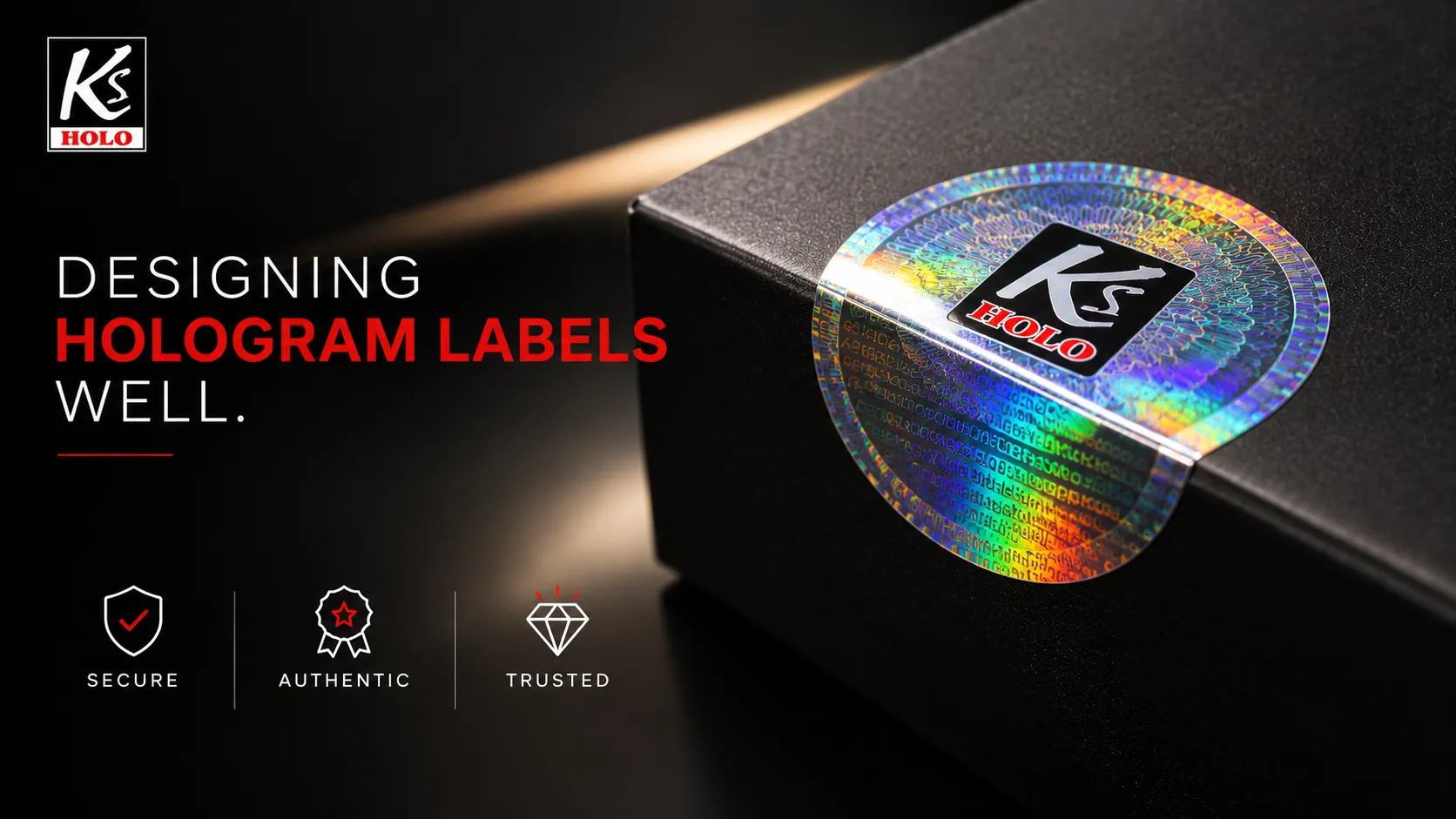
Designing hologram labels well means balancing optical security, brand recognition, and production constraints—not only label aesthetic. An effective design locks registered artwork, readable size, and a check anyone can learn in seconds, then moves cleanly from vector files to master and print.
DEFINITION
Definition — Designing hologram labels is the process of specifying holographic label graphics, security features, size, substrate behaviour, and verification behaviour so a sticker authenticates a product rather than acting as decorative foil; in India, custom hologram label design typically combines brand marks with diffractive effects that ordinary printers and photocopiers cannot reproduce.
Most brand teams start with a logo file and ask for “something shiny.” That brief fails in the market. Counterfeiters chase categories buyers already distrust: ASPA–Crisil 2025 coverage found consumers estimated about 29% of products in local markets were counterfeit, with apparel and consumer electronics among the most affected. A hologram only helps if the design is recognisable, hard to clone, and manufacturable. That is the real job of designing hologram labels.
EVIDENCE
ISO 22383:2020 gives guidelines for selecting and evaluating authentication solutions after a counterfeiting risk assessment—so design choices should follow who must verify the good, and under what conditions, not only how the label looks in a mock-up.
Source: ISO 22383:2020
What makes a hologram label design effective?
Effectiveness is measured at the point of check—warehouse, retailer, or buyer—not in a design review alone.
What makes a hologram label design effective?
QUICK ANSWER
An effective hologram label design combines a hard-to-copy optical structure with a brand-readable mark, a size that fits the pack, and a verification cue staff can learn quickly. Security features must survive real substrates and handling. Decorative foil without registered artwork or a clear check fails as soon as lookalike packs appear.
Use these hologram sticker design tips as a procurement filter:
- Overt cue — colour-shift, 2D/3D depth, or kinetic effect visible without tools.
- Brand lock — logo or wordmark registered into the hologram, not only printed beside it.
- Readable scale — micro-text or fine lines only if the die size can hold them.
- Placement rule — same corner on every SKU so channel staff know where to look.
- Tamper path — void or destruct construction when opening must leave evidence.
If you need a foundation on how optical security works before artwork begins, start with What Are Hologram Security Stickers and How Do They Work?.
MYTH
“A brighter foil and a bigger logo automatically make a stronger security sticker.”
REALITY
Brightness is easy to imitate. Strength comes from controlled holographic label graphics, registered masters, and features matched to who verifies the pack. Overfilled artwork often loses fine security detail at small die sizes.
How do I create a custom hologram sticker design?
How do I create a custom hologram sticker design?
QUICK ANSWER
Create a custom hologram sticker design by defining the verification job first, choosing construction (2D/3D, void, hybrid), locking size and placement, then preparing clean vector artwork for origination. Approve a physical sample on your real pack before mass production. Treat the hologram master like tooling—not a marketing print file anyone can reprint.
STEP-BY-STEP
- Define the check — who must accept or reject the pack in under a minute?
- Choose construction — brand hologram only, void seal, or QR-plus-hologram hybrid.
- Pick size and shape — match pouch, carton flap, bottle, or warranty panel.
- Build the graphic hierarchy — brand mark first; security effects second; avoid clutter.
- Prepare artwork — vector logo, outlined fonts, correct colours, bleed and safe area.
- Origination review — manufacturer maps which effects are optically possible at your size.
- Sample on real substrate — approve adhesion, peel, and visual cue before the full run.
| Design decision | Prefer when… | Avoid when… |
|---|---|---|
| Custom 2D/3D security hologram | Brand authentication is the main job | You only need “opened / not opened” evidence |
| Void / tamper-evident hologram | Warranty or reseal detection matters | Buyers must read dense text on the seal |
| Dense micro-text + logos | Die size is large enough | Seal is under ~10–12 mm |
| QR + hologram hybrid | You will govern serial data and responses | You only need a visual authenticity cue |
Choosing depth versus flat registered graphics is a common fork; 3D vs 2D Hologram Stickers: Which Should You Choose? walks through that trade-off.
DID YOU KNOW?
ASPA notes it developed Hologram Safety and Security Management Standards (HSSMS) with TÜV Rheinland India—an industry signal that hologram programmes are treated as managed security systems, not casual print jobs.
Source: ASPA — About
What file format is needed to design a hologram label?
What file format is needed to design a hologram label?
QUICK ANSWER
Manufacturers typically need vector artwork—commonly Adobe Illustrator (.ai), EPS, or PDF with outlined fonts—plus a high-resolution preview for layout reference. Raster-only files (JPEG/PNG) can show intent but are weak for clean origination. Confirm hologram label artwork requirements with your printer before you send artwork for hologram printing.
Practical artwork package for custom hologram label design India programmes:
- Master vectors — logo and key line art as editable/outlined vectors.
- Fonts — convert to outlines or embed; note any mandatory legal micro-copy.
- Colour intent — brand PMS/CMYK notes; holographic colour-shift is optical, not flat ink.
- Die line — exact size, shape, and corner radii; mark safe area.
- Placement photo — pack photo or dieline showing where the seal sits.
- Security brief — void text, micro-feature preference, QR reserved zone if hybrid.
| File type | Useful for | Limitation |
|---|---|---|
| AI / EPS / PDF (vector) | Origination and clean edges | Must be final, not a draft sketch |
| High-res PNG / JPEG | Visual mock-up only | Soft edges; poor for micro-features |
| CAD / pack dieline | Placement and die fit | Does not replace holographic master design |
| Brand guidelines PDF | Hierarchy and clear-space rules | Not a substitute for production-ready vectors |
EVIDENCE
The OECD–EUIPO *Mapping Global Trade in Fakes 2025* estimates counterfeit and pirated goods at about USD 467 billion in 2021 (~2.3% of world trade)—which is why brands invest in authentication elements that raise cloning cost, not only in packaging look-and-feel.
Indian context: design control, ASPA, and brand protection
In India, how to design a security sticker is inseparable from who controls the master. A downloaded “hologram PSD” shared across vendors leaks the only advantage you have. ASPA (Authentication Solution Providers’ Association)—active since 1998, with 80+ member companies—frames authentication as an industry ecosystem of physical and digital solutions. Procurement language therefore often asks for manufacturer credentials and controlled artwork, not only the lowest sticker MOQ.
Indian trademark law also frames why design integrity matters commercially: the Trade Marks Act, 1999 provides remedies against infringement and deceptive similarity. A hologram does not replace legal action, but a registered, controlled seal strengthens the practical ability to spot and refuse lookalike stock in the channel.
EXPERT OPINION
“In India, counterfeiting incidents have increased over the past three years, with counterfeiters becoming increasingly sophisticated and better funded. The growth of ecommerce and globalisation of markets has made the fight against counterfeiting even more challenging.”
— Ankit Gupta, President, ASPA (quoted in BW Businessworld coverage of the ASPA–Crisil 2025 report)
Source: BW Businessworld
| Buyer priority | Specify in the design brief | Why it matters |
|---|---|---|
| Fast visual check | Simple registered mark + strong optical cue | Channel staff learn one genuine look |
| Artwork security | Controlled master; no open vendor sharing | Reduces clone risk from file leakage |
| Tamper evidence | Void / residual message on removal | Shows resealed cartons or warranty panels |
| Future digital layer | Quiet zone for QR / serial | Upgrade path without redesigning the whole seal |
| Vendor continuity | In-house design + manufacturing capability | Same look across reorders and audits |
FIRST-HAND EXPERIENCE
In day-to-day origination for Indian brands, the brief that works is rarely “make it premium.” It is “make authenticity obvious at packing-line speed.” Teams that send incomplete raster logos delay tooling; teams that lock size, substrate, and a one-page visual guide move faster from sample to production. KS Holo has manufactured security holograms in India since 2002 as an ASPA founder-member with end-to-end in-house production—including design support that maps brand artwork into manufacturable holographic effects before the master is cut.
When you are ready to send artwork for hologram printing—or need help converting brand files into a manufacturable security design—request a design-to-sample discussion with KS Holo on WhatsApp. For vendor questions beyond design, How to Choose a Hologram Label Manufacturer: 5 Key Questions is a useful checklist.
Frequently Asked Questions
Can my marketing agency design the hologram alone and just send a PDF?
QUICK ANSWER
An agency can prepare brand hierarchy and layout intent, but holographic origination is different from flat-print design. Effects such as colour-shift, 2D/3D depth, and micro-features must be engineered for the die size and film. Best practice is joint review: agency vectors plus manufacturer security mapping before the master is approved.
What size works best when designing hologram labels for small pouches?
QUICK ANSWER
Most small accessories and sachets use compact seals—often roughly 8–20 mm depending on pack real estate. At very small sizes, simplify: one clear brand cue and one strong optical effect beat crowded micro-text. Always sample adhesion on the real pouch film before locking the die.
Do I need void text if I only want brand authentication?
QUICK ANSWER
Not always. Use a custom security hologram when the main job is “is this pack genuine?” Add void or destruct constructions when the main job is “was this opened or resealed?” Many warranty cartons combine both. Match the construction to the verification moment, not to a default catalogue option.
Should holographic label graphics match my primary packaging print exactly?
QUICK ANSWER
They should feel on-brand, but exact CMYK matching is the wrong goal—holographic colour is angle-dependent. Align logo geometry, proportions, and hierarchy with brand guidelines, then accept that the security film will shift under tilt. Consistency of placement and registered artwork matters more than perfect ink colour match.
What should I include when I send artwork for hologram printing in India?
QUICK ANSWER
Send final vectors (AI/EPS/PDF), outlined fonts, die size, pack placement, substrate notes, and whether you need void, micro-features, or a QR zone. Add a one-line verification brief: who checks the seal and what they must see. Incomplete briefs cause redesign loops after sampling.
Is in-house manufacturer design better than buying a generic hologram template?
QUICK ANSWER
Generic templates are easier for counterfeiters to source and reuse. Custom hologram label design India programmes that keep registered masters under controlled supply raise cloning cost and support audits. Evaluate design capability, master control, and production continuity—not only unit sticker price.
QUICK SUMMARY
Do brands need a structured design process when designing hologram labels?
Yes—if the seal must authenticate products, not only decorate packs.
A strong design-to-print workflow can:
- ✓ Lock registered, hard-to-copy holographic label graphics
- ✓ Match size, substrate, and channel verification behaviour
- ✓ Clarify artwork requirements before tooling
- ✓ Support later void or QR upgrades without starting over
It cannot replace:
- ✗ Channel training and accept/reject rules
- ✗ Legal enforcement against infringers
- ✗ Secure control of masters and vendor access
Sources
- ISO 22383:2020 — Guidelines for selection and performance evaluation of authentication solutions
- OECD–EUIPO — Mapping Global Trade in Fakes 2025
- BW Businessworld — ASPA–Crisil State of Counterfeiting in India 2025 coverage
- ASPA — About the Association
- ICC BASCAP — Business Action to Stop Counterfeiting and Piracy
- India Code — Trade Marks Act, 1999
- KS Holo