
What Are Hologram Security Stickers and How Do They Work?
The State of Counterfeiting in India 2025 report by ASPA and Crisil Intelligence found that 89% of urban Indian consumers have purchased a fake product at least once — and 35% encountered counterfeit goods in the last year alone. For Indian brand owners, that is not a market research footnote. It is a direct threat to revenue, reputation, and consumer trust. Hologram security stickers are the physical barrier that sits between your genuine product and its counterfeit copy. This guide explains exactly what they are, how the technology works, and what separates a reliable security hologram from one that only looks the part.
What Are Hologram Security Stickers — and What Makes Them “Secure”?
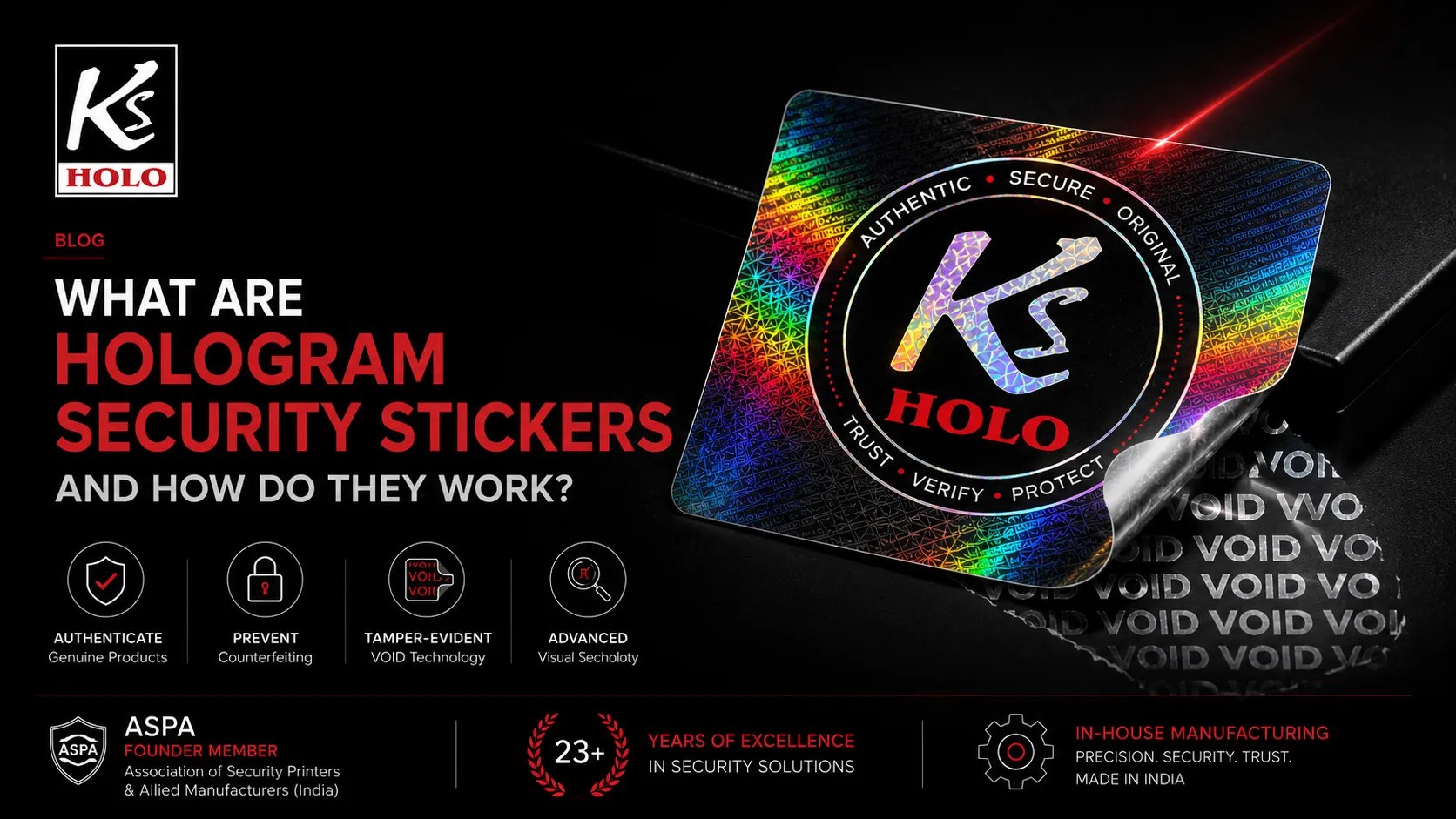
A hologram security sticker is a label that uses light-diffraction technology to produce a colour-shifting optical effect that cannot be replicated by any standard printing or photocopying process. Unlike a printed label or a standalone QR code, a genuine hologram requires a master recording, precision metallic film, and controlled manufacturing conditions — equipment a counterfeiter cannot access economically.
The security comes from three layers working together. The first is the visible diffractive pattern — the colour-shift effect that consumers see when they tilt the product. The second is the concealed layer: micro-text, laser-readable codes, or hidden images that are invisible to the naked eye and require specialist verification. The third, on tamper-evident variants, is the physical response layer — typically a VOID hologram that permanently marks the product surface if any removal is attempted.
Together, these layers serve two distinct audiences: the end consumer, who can authenticate at a glance by tilting the product, and the brand’s quality or compliance team, which can verify authenticity through the technical hidden features.
Online aggregator platforms now account for 53% of all counterfeit purchases in India — making physical authentication on packaging more important than ever before, according to the State of Counterfeiting in India 2025.
Source: ASPA–Crisil Intelligence, State of Counterfeiting in India 2025
How Do Hologram Security Stickers Work? The Science Made Simple
Every hologram security sticker begins with a master recording process. A laser beam is split into two paths: the object beam and the reference beam. The object beam illuminates the subject — a physical object or a precisely designed digital pattern — and the reflected light collides with the reference beam on a photosensitive medium. This interference pattern is recorded at microscopic precision, creating what is known as a diffraction grating.
This diffraction grating — etched at nanometre-level precision into metallic film — is what generates the colour-shift. When white light strikes the grating, different wavelengths (colours) are reflected at different angles. The result is the rainbow-shimmer that consumers associate with a genuine security hologram.
How does a hologram sticker prevent counterfeiting?
A hologram sticker prevents counterfeiting because its visual effect is produced by a diffraction grating — a microscopic pattern etched at nanometre precision into metallic film. This pattern cannot be scanned, photographed, or reprinted by any standard commercial printer. Any copy loses the colour-shift effect entirely, making it immediately identifiable as a fake to an informed consumer or distributor.
When a genuine hologram security sticker is tilted, its colour sequence shifts in a defined, multi-layer pattern. A counterfeit version produced by offset or digital printing appears flat and static under the same movement. This visual test requires no app, no scanner, and no technical knowledge — it is the consumer’s first and most accessible verification tool.
What is a diffraction grating label?
A diffraction grating label is a holographic security label whose optical effects are produced by microscopic ridges — the diffraction grating — that split and reflect light at varying wavelengths to produce colour-shifting patterns. In India, diffraction grating labels are widely used as tamper-evident holograms on pharmaceutical packaging, FMCG products, and branded apparel as a physical anti-counterfeiting layer.
Five Types of Hologram Security Stickers Used in India
Not all hologram security stickers offer the same level of protection. Choosing the right type depends on your industry, the value of the product, and the regulatory environment. Here is a practical comparison of the five types most commonly specified by Indian brands:
| Type | Security Level | Key Feature | Best For |
|---|---|---|---|
| Standard 2D/3D Hologram | Medium | Colour-shifting optical effect, custom design | General FMCG, retail packaging |
| VOID Hologram | High | Reveals “VOID” or custom text on removal | Warranty seals, premium goods, electronics |
| Tamper-Evident Hologram | High | Permanently marks or destroys on any removal attempt | Pharma, certified products, high-value exports |
| ASPA-Certified Hologram | Highest | Micro-text, laser dot, and hidden image — mandated spec | Government supply, regulated industries, BIS compliance |
| QR + Hologram Hybrid | Highest + Digital | Physical security combined with digital track-and-trace | Premium FMCG, supply chain verified brands, serialisation |
The most common mistake Indian brand owners make is specifying a standard 2D hologram when their product and sector demand a tamper-evident or ASPA-certified label. The visible effect may look similar to an untrained eye — but the security level is not comparable.
Which Indian Industries Need Hologram Security Stickers — and Why
The 2025 ASPA counterfeiting research confirms the scale of the challenge across sectors. According to ASPA and Crisil Intelligence, counterfeit medicines account for 28% of India’s pharmaceutical market, apparel counterfeiting affects 31% of urban consumers, and FMCG products face 27% fake exposure. Each sector has a distinct requirement for hologram security stickers.
- Pharmaceuticals: drug authentication holograms are mandated under regulatory guidelines; counterfeit medicines represent a consumer safety emergency, not just a business risk
- FMCG and packaged food: brands use anti-counterfeiting holograms to authenticate premium and health products at retail, where visual verification is the only consumer-facing check
- Apparel and fashion: holographic authentication tags and woven label combinations protect brand equity in a sector where one in three urban Indian consumers has encountered a fake
- Electronics and consumer durables: VOID and tamper-evident holograms protect warranty integrity and genuine spare parts ecosystems
- Auto components: tamper-evident labels protect against the 22% of consumers who encounter counterfeit spare parts — a direct safety and liability risk
Are hologram security stickers legally required on Indian products?
Hologram security stickers are legally required on specific product categories in India under the BIS mandatory certification scheme, the DPIIT security hologram programme, and drug authentication requirements under the Drugs & Cosmetics Act. Brands in regulated categories — including pharmaceuticals, BIS-certified electronics, and certain FMCG goods — must affix approved security labels as a compliance requirement, not merely a brand choice.
Brand owners across these sectors can request custom hologram security stickers with the right security tier for their specific industry from KS Holo — as an ASPA founder-member with 20+ years of in-house production in Delhi, the team can specify and supply compliant labels at any volume. Get a custom quote on WhatsApp.
How to Choose a Hologram Security Sticker Manufacturer in India
For procurement managers, choosing a hologram security sticker supplier is a vendor evaluation exercise with direct compliance and brand risk implications. Five criteria matter most:
- ASPA membership: the single most reliable quality signal in India’s hologram industry; ASPA-member manufacturers are bound by minimum security specifications and audit standards
- End-to-end in-house production: outsourcing any stage of hologram manufacturing introduces quality inconsistency and confidentiality risk — your design, your security features, and your production data must not leave the supplier’s facility
- Sample process: any credible manufacturer will produce a physical sample before full order commitment; if a supplier cannot offer this, treat it as a red flag
- Security tier options: a manufacturer offering only one generic product cannot match your industry’s specific requirements; the right partner offers a range from standard 2D to ASPA-certified tamper-evident
- Track record and tenure: in security printing, years in business correlate directly with technical knowledge; a manufacturer established for 20+ years has encountered — and solved — the security challenges newer entrants haven’t yet faced
What does ASPA-certified hologram mean for product quality?
An ASPA-certified hologram meets the technical standards set by the Authentication Solution Providers’ Association — India’s governing body for anti-counterfeiting technology manufacturers. ASPA-certified holograms include mandatory security features such as micro-text, laser dot, and hidden image elements. In India, major brands and government procurement specifically require ASPA certification when sourcing hologram stickers for regulated or high-value product categories.
“Any hologram sticker is enough to protect my brand from counterfeiting.”
A hologram sticker is a deterrent and authentication tool — not a blanket guarantee. Its effectiveness depends entirely on the security tier specified, the consistency of application across all product units, and consumer awareness of what the genuine hologram looks like. A low-cost 2D hologram from an uncertified source provides a visible effect, but lacks the hidden features that make verification technically reliable for distributors and compliance teams.
Only 36% of Indian consumers who buy counterfeit goods cite price as their main motivation — the majority simply cannot distinguish genuine packaging from a well-made fake. The physical impossibility of replicating an ASPA-certified hologram closes this gap at the product level.
Source: ASPA–Crisil Intelligence, State of Counterfeiting in India 2025
Frequently Asked Questions
Hologram security stickers are used to authenticate genuine products and deter counterfeiting. They are applied to product packaging, labels, and certificates across industries including pharmaceuticals, FMCG, apparel, electronics, and auto components. In India, they are also required as compliance labels for BIS-certified and DPIIT-regulated product categories.
Genuine ASPA-certified hologram security stickers cannot be replicated by standard commercial printing. The diffraction grating — etched at nanometre precision — requires a master hologram and specialised equipment to produce. Cheap imitations printed by offset or digital printers lose the colour-shift effect entirely and are identifiable as fakes under even basic scrutiny from a trained distributor or retailer.
A VOID label reveals a hidden message — typically “VOID” or a custom text — on the product surface when removed, permanently recording the tampering attempt. A tamper-evident hologram combines this void property with holographic security features — colour-shift, micro-text, and hidden elements — providing both a consumer-visible and a technically verifiable authentication layer in a single label.
KS Holo manufactures hologram security stickers in Delhi at New Mandoli Industrial Area. As an ASPA founder-member with 23+ years of end-to-end in-house production, KS Holo supplies custom security holograms to brands across pharma, FMCG, apparel, and industrial sectors. Contact via WhatsApp at +91-9310690117 or through ksholo.com/contact-us.
TL;DR — Hologram Sticker Essentials
- Physical barrier, not just visual: genuine hologram security stickers use diffraction grating technology that cannot be replicated by commercial printers — their security is physical, not cosmetic
- Security tier matters: a standard 2D hologram is not the same as an ASPA-certified tamper-evident label; specify the tier appropriate for your industry’s risk level and regulatory requirements
- Legal compliance in regulated sectors: pharma, BIS-certified electronics, and several FMCG categories require approved security holograms under Indian regulation — not just as a brand option
- Supplier credentials are the shortcut: ASPA membership, in-house production, and a sample-before-order process are the three criteria that eliminate unacceptable vendor risk
Choosing the right hologram security sticker is straightforward once you match the security tier to your sector’s actual risk level. KS Holo has manufactured ASPA-certified security holograms in India since 2002 — get a custom specification and sample on WhatsApp, or explore the full product range at ksholo.com/shop.