

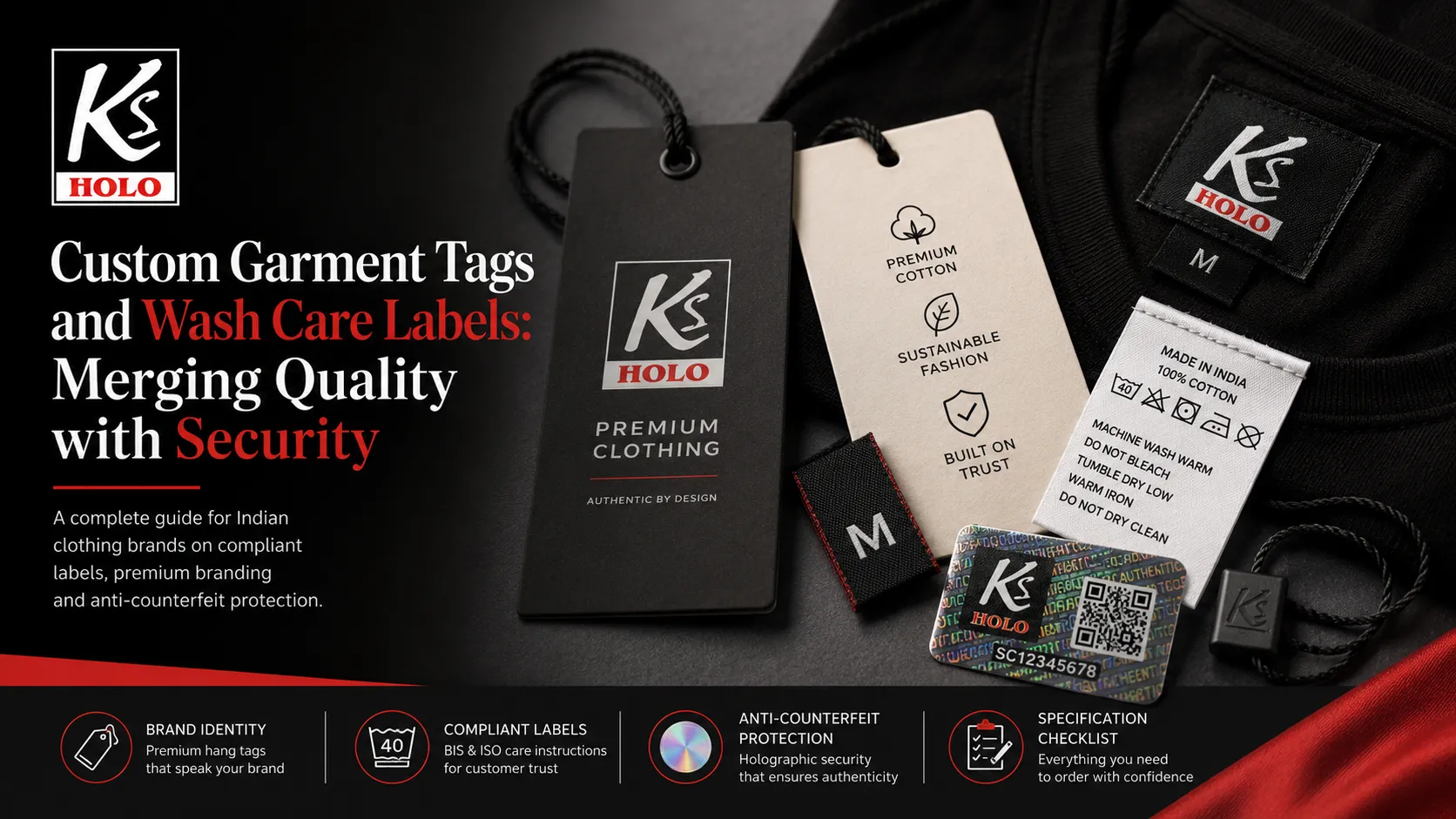
Custom Garment Tags and Wash Care Labels: Merging Quality with Security
A garment is finished when the last seam is pressed. But a brand is finished when the label is attached. Custom garment tags — hang tags, wash care labels, woven brand labels, and holographic security inserts — collectively represent one of the most concentrated brand and compliance touchpoints in the apparel supply chain. For Indian clothing brands competing across modern retail, e-commerce, and export markets, getting this label system right means integrating quality presentation, mandatory regulatory compliance, and increasingly, protection against a counterfeit market that targets garment brands with growing sophistication.
What Are Custom Garment Tags? Types and Functions
The term “garment tags” covers a family of label types, each with a distinct location, material, and function within a clothing product. Most Indian clothing brands use at least two or three tag types per garment — and larger brands typically manage four or five as a coordinated label system.
What are the types of custom garment tags available for clothing brands in India?
The five main types of custom garment tags are: Hang tags (printed card or paper, attached by pin or thread — brand identity and product story at point of sale); brand/main labels (woven or printed, sewn into collar or side seam — brand name and logo); wash care labels (sewn-in satin or taffeta — care symbols, fibre content, origin); size labels (woven or printed size indicators sewn inside the garment); and holographic security tags (tamper-evident labels or hang tag inserts that verify authenticity and deter counterfeiting).
| Tag Type | Location | Primary Function | Typical Material |
|---|---|---|---|
| Hang tag | Attached to garment by pin or thread | Brand identity, product info, pricing at point of sale | Coated card, uncoated paper, kraft board |
| Brand / main label | Sewn into collar or back neck seam | Brand name, logo, seasonal or collection mark | Woven fabric, printed satin, heat transfer |
| Wash care label | Sewn into left side seam or back neck | Care instructions, fibre content, country of origin | Satin ribbon, taffeta, printed polyester |
| Size label | Inside collar or waistband | Size designation (S/M/L or numeric) | Woven, printed, heat transfer |
| Holographic security tag | Applied to hang tag or garment seam | Anti-counterfeit verification, brand authenticity | Holographic film, tamper-evident adhesive |
Wash Care Labels — India’s Mandatory Requirements
Wash care labels in India are not optional — they are a statutory requirement under the Textiles (Consumer Protection) Regulations and aligned BIS standards governing textile products sold in the Indian market. As detailed in IGNOU’s academic curriculum on garment labelling — part of India’s national textile education framework — every garment sold in India must carry specific mandatory information that enables the consumer to identify the product’s composition and care requirements accurately.
What information is mandatory on wash care labels in India?
Under India’s Textiles (Consumer Protection) Regulations and BIS labelling standards, the following information is mandatory on garment labels: fibre or fabric composition (percentage breakdown of each fibre type); care instructions (wash, dry, iron, bleach, and dry-clean symbols conforming to IS/ISO care labelling standards); country of origin (Made in India or country of manufacture); manufacturer’s name and address; and size designation. For branded garments sold in modern retail, MRP, brand name, and product description are additionally required on the hang tag or main label.
The care symbols used on Indian garment wash care labels follow ISO 3758 / GINETEX internationally standardised icons — the same symbols recognised across export markets in the EU, UK, and GCC. This matters for Indian garment exporters: a wash care label that meets Indian domestic requirements using ISO-compliant symbols will also meet the labelling requirements of most major international markets, eliminating the cost of producing market-specific label variants for standard export programmes.
Wash care labels are produced in satin ribbon, taffeta, or printed polyester — all materials that withstand repeated machine washing, tumble drying, and commercial laundry cycles. The label must remain legible throughout the expected life of the garment; a wash care label that fades or peels after five washes is both a quality failure and a potential compliance issue.
Custom Hang Tags — Brand Identity at the Point of Sale
Of all garment tag types, the hang tag carries the heaviest brand communication burden at point of sale. It is the consumer’s first physical interaction with a garment before purchase — and a well-designed label tells a brand story before a customer even puts on the clothing. For Indian clothing brands competing in modern retail and D2C e-commerce, the hang tag is the primary opportunity to communicate brand values, quality positioning, and product story in the compressed, high-competition context of a retail fixture or a product listing photograph.
Effective hang tag design for Indian apparel brands should consider:
- Board weight and finish — premium brands typically use 300–400gsm coated card with matte or soft-touch laminate; fast-fashion and D2C labels use 250–300gsm with digital print for cost-efficient short runs
- Shape and die-cutting — rectangular is the most common format, but custom die-cut shapes (rounded corners, arch top, folded booklet) differentiate on shelf and signal investment in brand detail
- Attachment method — brass eyelets with cotton or polyester cord signal quality; plastic barb pins are functional for fast-fashion and mid-market; wax thread loops suit premium and artisanal brands
- Foil and embellishment — hot foil stamping on brand name or logo adds a premium material signal; spot UV lacquer over a matte base creates tactile contrast
- Functional content — barcode, QR code, price point, size, and care icon can all be incorporated without crowding the front-face design
Leading clothing brands are now using QR codes printed on hang tags to create a digital brand extension — directing consumers to online care instructions, styling lookbooks, sustainability credentials, and even digital certificates of authenticity. For Indian D2C clothing brands selling on platforms like Myntra, Flipkart, and their own websites, a QR code on the hang tag bridges the physical product to the digital brand experience, extending the brand interaction well beyond the point of purchase.
Source: Quality Woven Labels — Why Garment Tags Are More Important Than You Think
Security in Garment Tags — The Anti-Counterfeit Dimension
India’s branded garment market faces a significant and growing counterfeiting problem. Replica garments carrying premium brand hang tags, woven brand labels, and even wash care labels are produced at scale and sold through informal channels, marketplaces, and increasingly through e-commerce listings that are difficult to distinguish from authorised retail. The damage extends beyond revenue loss: counterfeit garments associated with a brand that has invested in quality manufacture erode consumer trust and brand equity.
End buyers are increasingly attentive to the transparency and traceability of the production chain — a label that certifies the authenticity of a garment or its components is a distinctive element that influences the purchasing decision. For Indian clothing brands operating in modern retail and online marketplaces, a visible security feature on the hang tag communicates authentic provenance where a printed label alone cannot.
“A premium-looking printed hang tag is sufficient to signal brand authenticity. Consumers recognise quality, and counterfeiters won’t invest in replicating it.”
Printed hang tags — even premium, foil-stamped ones — can be replicated by counterfeiters with access to a commercial print shop. A convincing replica tag can be produced for a few paise per unit once the original design is photographed and reconstructed. Security features that are not replicable on standard printing equipment are the only reliable deterrent: holographic inserts on hang tags incorporate optically variable diffraction grating patterns that shift colour and pattern under different lighting angles — something no inkjet or offset press can produce. Tamper-evident holographic labels applied over the hang tag attachment point add a second layer: any attempt to remove the tag for reuse destroys the hologram, making re-tagging counterfeit garments as authentic products operationally difficult at scale.
The security features most commonly applied to Indian garment hang tags and clothing labels include holographic inserts embedded in the card, sequential serial numbering linked to a product authentication database, QR codes that resolve to a live verification page, and tamper-evident holographic stickers applied over the attachment cord or across the card fold. For a detailed technical overview of how holographic security labels work, see What Are Hologram Security Stickers and How Do They Work?
India’s counterfeit branded apparel problem is not limited to street markets and unauthorised retail — independent research on Indian e-commerce marketplace listings consistently finds counterfeit branded garments listed alongside genuine products, often with near-identical product photography. For Indian clothing brands with a meaningful brand presence, a holographic authentication feature on the hang tag provides a consumer-verifiable signal of genuine product that marketplace photography cannot replicate — and gives both the brand and the consumer a mechanism to distinguish authentic from counterfeit in the first moment of physical product contact.
Source: KS Holo brand protection advisory; Indian textile and garment industry counterfeit risk observations
Custom Garment Tags Across Clothing Categories
Tag specifications vary significantly by garment category — the label system appropriate for premium women’s ethnic wear is different from the requirements of a children’s school uniform or an industrial workwear range. A capable garment tag manufacturer in India should be able to advise on category-appropriate specifications, not just execute a brief.
- Premium and luxury apparel — woven main labels with Pantone-matched thread; 350–400gsm hang tags with soft-touch laminate, foil stamping, and holographic security insert; cotton attachment cord; care labels in satin ribbon with ISO care symbols
- D2C and direct-to-consumer fashion — digital-printed hang tags (low MOQ, design flexibility for seasonal variants); QR code on hang tag for digital brand extension; kraft or recycled card board for eco-brand positioning
- Children’s apparel — soft care labels using heat transfer or printed cotton to eliminate itchiness; hang tags with barb-free attachment for child safety compliance; mandatory fibre content and care information in legible large font
- Ethnic and handloom garments — hang tags with craft story narrative; GI (Geographical Indication) authentication labels for certified handloom products; woven labels incorporating regional craft symbols
- Industrial and workwear — durable satin care labels rated for industrial laundering temperatures; EN/ISO standard compliance markings; batch and production date coding for quality traceability
- Sportswear and activewear — heat transfer labels eliminating the irritation of sewn-in labels in high-contact areas; moisture-resistant care labels; holographic authenticity tags for branded sportswear subject to counterfeiting
Specifying Custom Garment Tags: What to Brief Your Manufacturer
What information do I need to provide for custom hang tag printing in India?
For custom hang tag printing, specify: dimensions (length × width in mm), board weight (gsm), finish (matte, gloss, soft-touch, kraft, or foil accent), colour mode (CMYK or Pantone), hole position and eyelet type, barcode or QR requirements, any foil or embossing, and whether a holographic security insert is needed. For wash care labels: care symbol set (ISO 3758/GINETEX), label material (satin, taffeta, cotton, or polyester), attachment method, and regulatory information fields (fibre content, origin, manufacturer details). Always request pre-production samples on your garment before confirming any production run.
Use these specification categories when briefing a custom hang tag printing supplier in Delhi or elsewhere in India:
Length × width in mm; shape (rectangular, rounded, die-cut); fold format (single or booklet)
250–400gsm coated card; uncoated; kraft; or recycled board — specify weight and surface texture
Matte laminate, gloss laminate, soft-touch, spot UV, hot foil stamp (gold/silver/holographic), or emboss
CMYK or Pantone; 2-sided or 1-sided; print-ready vector artwork in AI/EPS/PDF with 3mm bleed
Hole diameter and position; eyelet material (brass, silver, or no eyelet); cord type (cotton, polyester, wax, or plastic barb)
Holographic insert type; sequential serial number; QR code linked to verification URL; tamper-evident holographic sticker position
Satin ribbon, taffeta, printed polyester, or cotton tape; width (typically 20–25mm); folded or straight-cut
ISO 3758 / GINETEX care symbols; mandatory fields: wash temp, dry, iron, bleach, dry-clean, fibre %, origin, brand
For guidance on label finish choices for hang tags — matte vs gloss vs kraft card stock — see Matte vs Gloss vs Kraft Paper Labels: Which Finish Is Right for Your Product?
Frequently Asked Questions
Under India’s Textiles (Consumer Protection) Regulations and BIS standards, garment labels must include: fibre or fabric composition (percentage of each fibre), care instructions using IS/ISO-compliant care symbols, country of origin, manufacturer’s name and address, and size designation. For branded garments in modern retail, MRP and brand name are additionally required. ISO 3758/GINETEX care symbols used on Indian labels are also valid for EU, UK, and GCC export market requirements.
The main types are: hang tags (printed card attached by pin or cord — brand identity at point of sale), brand/main labels (woven or printed, sewn into collar — logo and brand name), wash care labels (sewn-in satin or taffeta with care symbols, fibre content, origin), size labels (inside collar or waistband), and holographic security tags (tamper-evident labels verifying garment authenticity). Most Indian clothing brands use at least three of these types in a coordinated label system per garment.
Holographic security tags incorporate optically variable diffraction grating patterns that cannot be reproduced using standard printing equipment. Applied to a hang tag or garment, they provide a visible, consumer-verifiable authentication feature. Advanced implementations include unique serial numbers, QR codes linked to a live authentication database, and tamper-evident adhesive that destroys the hologram if removal is attempted — making re-tagging counterfeit garments as genuine products operationally difficult. For Indian brands in modern retail and e-commerce, holographic tags create a provenance signal that printed labels alone cannot provide.
Specify: dimensions (mm), board weight (gsm), finish (matte, gloss, soft-touch, foil), colour mode (CMYK or Pantone), hole and eyelet details, attachment cord type, barcode or QR requirements, any security feature (holographic insert, serial number), and print-ready vector artwork with bleed. For wash care labels, additionally specify the care symbol standard (ISO 3758/GINETEX), label material, width, and the mandatory regulatory information fields. Always request pre-production samples attached to your actual garment before confirming a production run.
TL;DR — Key Takeaways
- Custom garment tags are a coordinated system — hang tags, wash care labels, brand labels, size labels, and security tags each serve a distinct function, and treating them as separate orders rather than a unified specification undermines brand coherence
- Wash care labels in India must comply with the Textiles (Consumer Protection) Regulations — fibre content, ISO care symbols, country of origin, and manufacturer details are all mandatory, not optional
- A printed hang tag — even a premium one — can be replicated by counterfeiters; holographic inserts and tamper-evident security features on hang tags create a provenance verification mechanism that standard print cannot replicate
- QR codes on hang tags bridge physical garments to digital brand experiences — care instructions, styling content, sustainability credentials, and authentication databases can all be accessed from the garment before and after purchase
KS Holo manufactures custom garment tags, wash care labels, and holographic security inserts from its Delhi production facility — paper labels, garment tags, and security holograms produced in-house since 2002, as a founder-member of ASPA. Request samples and a specification quote via WhatsApp or browse the full range at ksholo.com/shop.