

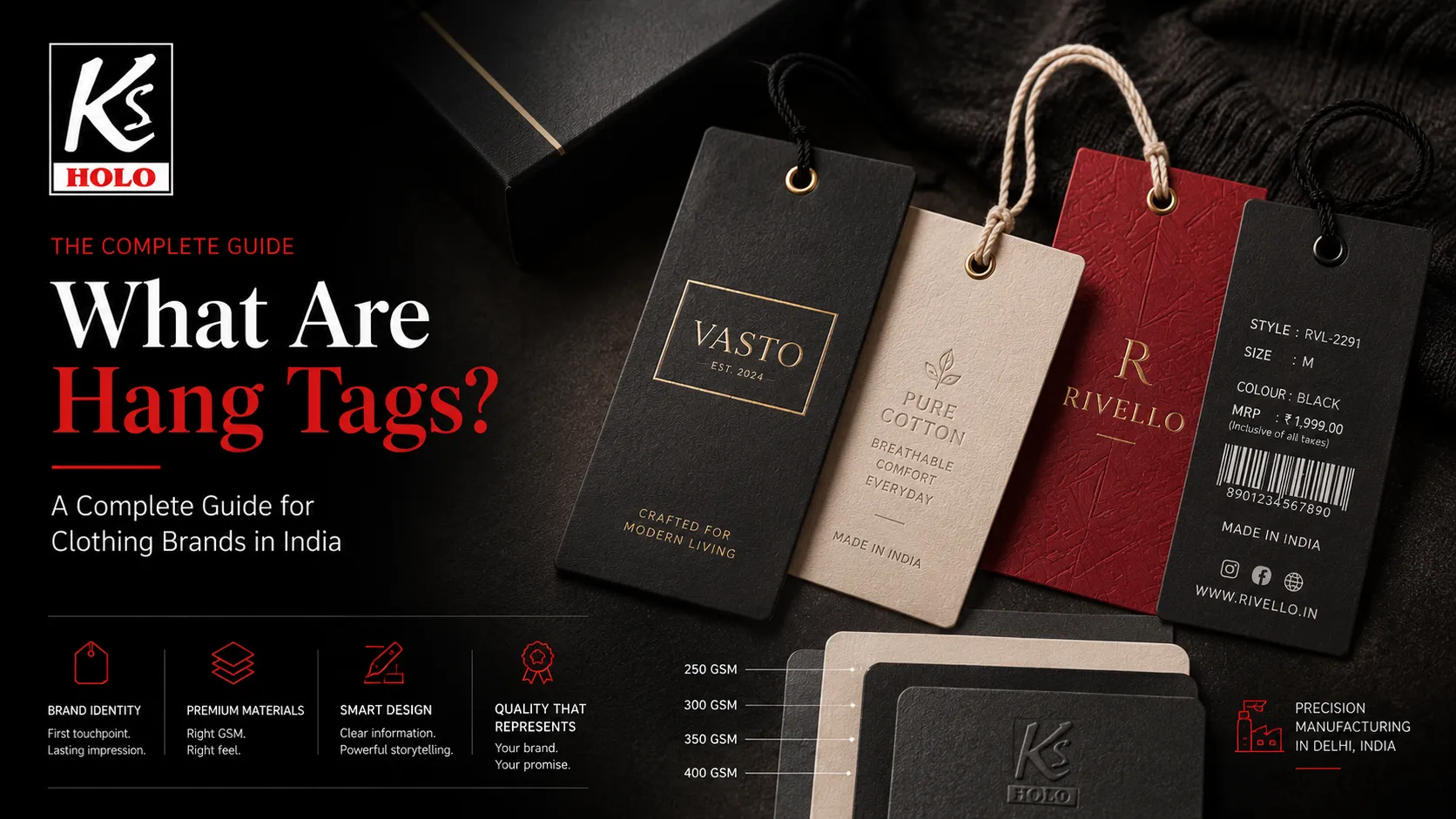
What Are Hang Tags? A Complete Guide for Clothing Brands in India
Walk through the menswear section of any organised retail store in India — from the value end to the premium end — and you will find one consistent element across every product: a small card hanging from a pin or cord. That card is a hang tag, and for clothing brands across India, it is the single most concentrated moment of brand communication before a purchase decision is made. Understanding what hang tags are, what they should carry, and how to specify them correctly is not a small detail — it is a fundamental part of presenting a clothing brand with the quality it deserves.
What Is a Hang Tag? Definition and Purpose
A hang tag is a label attached to a product using a thread or tie rather than an adhesive. Usually made from heavier card or paper stock, it is die-cut with a hole so it can be hung from the garment — threaded onto a hanger, pinned through a button loop, or tied to a zip pull. Unlike sewn-in brand labels or wash care labels (which are permanent garment components), a hang tag is designed to be removed by the consumer at the point of wearing.
What is a hang tag on clothing?
A hang tag is a card or paper label attached to a garment using a cord, string, or plastic pin. It carries the brand name, logo, price, and product details, and serves as the primary brand communication touchpoint at point of sale. Unlike sewn-in labels, it is intended to be removed before wearing. It is also the first place potential customers look for important information about a product — sizing, price, and garment details — making it both a functional label and a brand selling tool.
Hang tags sit at the intersection of retail function and brand storytelling. They need to communicate product information clearly and quickly — because a shopper at a rail has three to five seconds to read a tag — while simultaneously communicating brand quality through the materials and finish they are produced on. A hang tag produced on flimsy paper with a blurry barcode tells a different brand story than the same garment tagged with a 350gsm soft-touch card with a foil-embossed logo. The garment is the same. The perception is not.
For the complete garment label system — including wash care labels, woven brand labels, size labels, and holographic security tags — see Custom Garment Tags and Wash Care Labels: Merging Quality with Security. This guide focuses specifically on hang tags and how to get them right.
What Information Should a Hang Tag Include?
The information carried on a hang tag serves two distinct purposes: brand communication (front face) and functional/compliance information (reverse face). These two functions should be treated as separate design layers — conflating them produces a tag that does neither well.
What information should be on a hang tag for Indian clothing brands?
A hang tag for Indian retail must include: brand name and logo; Maximum Retail Price (MRP) inclusive of taxes (mandatory under India’s Legal Metrology Act for packaged and retail-tagged goods); size; product description; fibre or fabric composition; care instructions or a reference to the sewn-in wash care label; barcode or QR code; country of origin (Made in India); and manufacturer or importer name and address. Front face: brand identity. Reverse face: functional and compliance information.
| Hang Tag Face | Content Element | Purpose | Required for Indian Retail? |
|---|---|---|---|
| Front | Brand name & logo | Brand identity & recognition | Brand requirement |
| Front | Product name / collection | Brand storytelling & positioning | Optional |
| Front / Reverse | MRP (incl. taxes) | Apparel price tag — consumer transparency | Yes — Legal Metrology Act |
| Reverse | Size designation | Consumer information at point of sale | Yes — Textiles Regulations |
| Reverse | Fibre / fabric composition | Consumer information & regulatory compliance | Yes — Textiles (Consumer Protection) Regulations |
| Reverse | Country of origin | Consumer transparency & regulatory compliance | Yes — Textiles Regulations |
| Reverse | Manufacturer / importer name & address | Accountability & traceability | Yes — Legal Metrology Act |
| Reverse | Barcode / QR code | Inventory management & digital brand extension | Required for modern retail / e-commerce |
| Reverse | Care icon or reference | Reinforces wash care label information | Optional (if care label is sewn in) |
The MRP requirement under India’s Legal Metrology (Packaged Commodities) Rules applies to most garments sold through retail channels. Brands selling direct-to-consumer online and attaching a price ticket with the hang tag must ensure the printed MRP matches the declared price on the shipping label and invoice. Discrepancies are a common source of compliance issues for fast-growing Indian D2C clothing brands when they transition from informal to organised retail.
Hang Tag Cardstock — Understanding GSM and Material Choices
The most consequential decision in hang tag production — beyond design — is cardstock. Premium hang tag cardstock is not a cosmetic upgrade; it determines how the tag feels in the hand, whether it holds up through transit and retail display without curling or tearing, and whether embellishments like foil or embossing can be applied without the board splitting.
Value / Fast Fashion
Lightweight, cost-efficient. Suitable for short runs and seasonal products. Limited embellishment capability.
Mid-Market Standard
Good rigidity and hand feel. Accepts matte or gloss laminate. The default for most organised Indian retail brands.
Premium / D2C
Noticeably stiff and heavy in hand. Supports soft-touch laminate, hot foil, and emboss. Preferred for premium Indian clothing brands.
Luxury
Board-like rigidity. Communicates quality before the tag is even read. Used by luxury and export-market apparel labels.
GSM stands for grams per square metre — the standard unit for measuring paper and cardstock weight. A higher GSM means a thicker, heavier card. Consumer research in the packaging and retail industry consistently shows that perceived product quality is influenced by tactile weight: a heavier, stiffer hang tag signals to the hand that the brand behind it has made a deliberate quality investment, even before the eye has read the brand name. For Indian clothing brands entering premium retail channels, upgrading from 250gsm to 350gsm coated card is one of the highest-return improvements available at minimal cost per unit.
Source: KS Holo hang tag production knowledge; retail packaging tactile quality research
Beyond weight, the surface treatment of the cardstock determines both aesthetic and practical performance:
- Matte laminate — flat, non-reflective, premium feel; slightly prone to fingermarks; ideal for minimalist and luxury brands
- Gloss laminate — high-shine, colour-saturated, photography-ready; ideal for fashion-forward D2C brands and sportswear
- Soft-touch (velvet) laminate — tactile matte surface with a suede-like feel; most premium option for hand feel; pairs well with foil or emboss
- Kraft uncoated — natural brown paper board; used by eco-conscious and artisanal brands; lower cost but limited colour gamut
- Recycled board — grey-fleck texture signals sustainable brand positioning; growing in use among Indian D2C brands with sustainability messaging
For a detailed comparison of matte, gloss, and kraft surface options across the full range of paper label and hang tag applications, see Matte vs Gloss vs Kraft Paper Labels: Which Finish Is Right for Your Product?
Custom Hang Tag Design — Getting It Right for Clothing Brands
A hang tag is a key selling tool for any retail environment — it gives your garments a finishing touch that can show a logo and introduce your brand story. The design brief for a custom hang tag must therefore balance two constraints that pull in opposite directions: maximise brand communication impact on a card that is typically 50 × 90mm to 55 × 100mm, while fitting in all the regulatory information required for Indian retail.
Size and shape
Standard hang tag dimensions used by Indian clothing brands range from 50 × 85mm to 55 × 100mm for portrait-format tags. Smaller format tags (40 × 70mm) are used for accessories and children’s wear. Die-cut shapes — rounded corners, arch-top, bookmark, or custom silhouettes — differentiate on the retail floor and signal investment in brand detail. Most commercial hang tag manufacturers in India and Delhi offer standard die shapes at no tooling surcharge; fully custom shapes require a one-time die cost.
Print and embellishment
Hang tag print methods in India range from digital print (low MOQ, fast turnaround, limited finish options) to offset print (higher MOQ, sharper colour, laminate and foil-ready). The embellishment hierarchy for branded clothing tags in India:
- Digital print only — entry-level; suitable for seasonal and short-run products
- Offset + matte or gloss laminate — standard for organised retail; clean, consistent, professional
- Offset + soft-touch laminate + hot foil stamp — brand name or logo in gold, silver, or rose-gold foil on soft-touch base; the most-used premium combination for Indian fashion brands
- Offset + soft-touch + foil + emboss or deboss — highest tactile impact; logo or brand name in raised or recessed relief; luxury positioning
- Offset + foil + holographic insert — premium brand identity with integrated anti-counterfeit feature; logo area incorporates a holographic film insert that cannot be replicated by standard printing
“The hang tag is just a price ticket. I’ll design it in Canva, print it at a local digital printer, and move on. Customers care about the garment, not the tag.”
The hang tag is the first physical object from your brand that a customer touches. Before the garment is even unfolded from the shelf, the tag has already communicated brand quality through its weight, rigidity, print sharpness, and finish. A 100gsm digitally-printed card with a pixellated barcode and misaligned text communicates that the brand does not invest in detail — which is precisely the opposite message a premium garment is trying to send. In organised Indian retail, category buyers and merchandisers also assess hang tag quality during brand listing reviews. A poorly produced hang tag has cost more than one Indian clothing brand a retail listing.
Attachment
How the hang tag is attached to the garment is part of the brand signal. Brass or silver eyelets on a thick card with cotton cord communicate craftsmanship; plastic barb pins communicate efficiency and scale. The choice should align with the brand’s positioning:
- Cotton or wax cord with brass eyelet — premium, artisanal, ethnic wear, and heritage brands
- Polyester cord with silver eyelet — mid-market, clean, professional
- Plastic barb pin — fast-fashion, value retail, workwear, high-volume production
- Ribbon loop — children’s wear and gift-grade packaging
Die-cut hang tag shapes are increasingly being used by Indian D2C clothing brands as a distinctive brand identity element. Rounded corners at a specific radius, an arch-top silhouette, or a brand-logo-shaped cut-out transform the hang tag from a generic rectangle into a recognisable brand asset that can be photographed and featured in flat-lay product photography — which is increasingly important on Myntra, Instagram, and direct-to-consumer brand websites. A die-cut hang tag shape costs no more per unit in volume production but delivers significantly higher brand recognition value in digital commerce photography.
Source: KS Holo hang tag design advisory; Indian D2C clothing brand production observations
Hang Tags for Different Clothing Brand Types in India
There is no universal hang tag specification. The right cardstock, finish, information layout, and attachment method for a clothing brand hang tag in India depends on the brand’s segment, channel, and consumer. A specification appropriate for a premium ethnic wear label would be over-engineered for a value workwear brand — and vice versa.
| Brand Segment | GSM | Finish | Key Feature | Attachment |
|---|---|---|---|---|
| Value / fast fashion | 250gsm | Gloss or uncoated | Price visibility, barcode | Plastic barb pin |
| D2C / direct brand | 300–350gsm | Matte or soft-touch | QR code, brand story, sustainability note | Polyester or cotton cord |
| Premium fashion | 350gsm | Soft-touch + foil stamp | Foil-embossed logo, brand narrative booklet fold | Cotton cord + brass eyelet |
| Luxury / export | 400gsm | Soft-touch + foil + emboss | Holographic insert, debossed logo, Pantone-matched cord | Wax-tipped cotton cord + brass eyelet |
| Ethnic / handloom | 300gsm | Kraft or recycled uncoated | Craft origin story, GI tag reference, natural cord | Natural jute or cotton cord |
| Children’s wear | 250–300gsm | Matte or gloss | Rounded corners, age-appropriate graphics, barb-free attachment | Ribbon loop or safety cord |
| Sportswear / activewear | 300gsm | Gloss or matte | Performance claim, QR code, barcode, minimal design | Plastic barb pin |
Briefing a Hang Tag Manufacturer in Delhi — What to Specify
What information do I need to provide for custom hang tag printing in India?
To brief a hang tag manufacturer in Delhi or elsewhere in India, provide: tag dimensions (width × height in mm), card weight (gsm), surface finish (matte/gloss/soft-touch/kraft), print colour mode (CMYK or specific Pantone), any embellishment (foil stamp — colour, area; emboss/deboss — area; holographic insert — position and type), hole diameter and position, eyelet material (brass, silver, or no eyelet), cord type and colour, quantity, and barcode or QR requirements. Supply print-ready vector artwork (AI, EPS, or print PDF) with 3mm bleed. Always request a physical pre-production sample before approving the production run.
Width × height in mm; shape (rectangular, rounded-corner radius, arch-top, or custom die-cut)
250 / 300 / 350 / 400gsm coated card; uncoated; kraft; or recycled board — specify gsm and surface
Matte laminate, gloss laminate, soft-touch laminate, or uncoated. Single-sided or double-sided
CMYK 4-colour process or Pantone spot colours; 1-sided or 2-sided print; digital or offset
Hot foil stamp (gold / silver / rose-gold / holographic foil); emboss / deboss; spot UV; or none
Hole diameter (typically 4–6mm); position (top centre); eyelet material (brass, silver, or punched hole only)
Cotton cord, polyester cord, wax-tipped cord, jute cord, or plastic barb pin — colour and length
Print-ready AI, EPS, or PDF with 3mm bleed; fonts outlined; images at 300dpi minimum
For Indian clothing brands placing their first custom hang tag order, the minimum order quantity from most Delhi-based printed hang tag suppliers ranges from 500 units for digital print to 1,000 units for offset print with laminate and foil. KS Holo accommodates short-run orders for product launches and seasonal variants — contact via WhatsApp to discuss quantities.
Frequently Asked Questions
A hang tag is a card or paper label attached to a garment using a cord, string, or plastic pin rather than adhesive. Typically made from heavy card stock, it carries the brand name, logo, size, price (MRP in India), and product details. It is the first physical touchpoint between a consumer and a clothing brand at point of sale — simultaneously a functional price ticket, a regulatory compliance label, and a brand identity communication tool.
250–280gsm is standard for value and fast-fashion hang tags. 300–320gsm is the mid-market standard for organised retail. 350gsm is preferred by premium and D2C clothing brands where the physical weight of the card communicates quality. 400gsm is used for luxury and export-grade hang tags where stiffness and rigidity are important. For any brand using soft-touch laminate, foil stamping, or embossing, 350gsm or heavier is recommended to provide a structural base for the finishing technique.
Under Indian retail compliance requirements: brand name and logo; MRP inclusive of taxes (Legal Metrology Act); size; fibre/fabric composition; country of origin; and manufacturer/importer name and address. For e-commerce and modern retail: barcode or QR code, product description or SKU, and care instructions (or reference to the sewn-in wash care label). Front face should carry brand identity elements; the reverse face should carry all functional and compliance information.
For digital print hang tags, most Indian manufacturers accept orders from 100–500 units. For offset print with laminate finish, the typical MOQ is 500–1,000 units. For hang tags with hot foil stamping, embossing, or holographic inserts, most manufacturers require 500–1,000 units minimum to recover plate and tooling costs. Delhi-based manufacturers including KS Holo can accommodate shorter runs for launches and seasonal variants. Always request a pre-production physical sample before confirming any production run.
TL;DR — Key Takeaways
- A hang tag is attached to clothing by cord or pin rather than adhesive — it is the first physical brand touchpoint a consumer has at point of sale, combining brand identity, pricing, and compliance information on a single card
- For Indian retail, a hang tag must carry MRP (inclusive of taxes), fibre composition, country of origin, size, and manufacturer details — these are legal requirements, not brand choices
- Cardstock weight (GSM) directly affects the perceived quality of a hang tag in the hand: 300gsm is the mid-market standard; 350gsm signals premium positioning; soft-touch laminate with foil is the most-used premium finish combination for Indian fashion brands
- Die-cut shapes, cotton cord attachments, and holographic inserts are the three lowest-cost hang tag upgrades with the highest brand perception return — particularly important for D2C brands where product photography is a primary marketing channel
KS Holo manufactures custom hang tags, printed garment labels, and holographic security inserts from its Delhi production facility — with over 20 years of experience serving Indian apparel brands since 2002. Request samples and a specification quote via WhatsApp or browse the full range at ksholo.com/shop.