
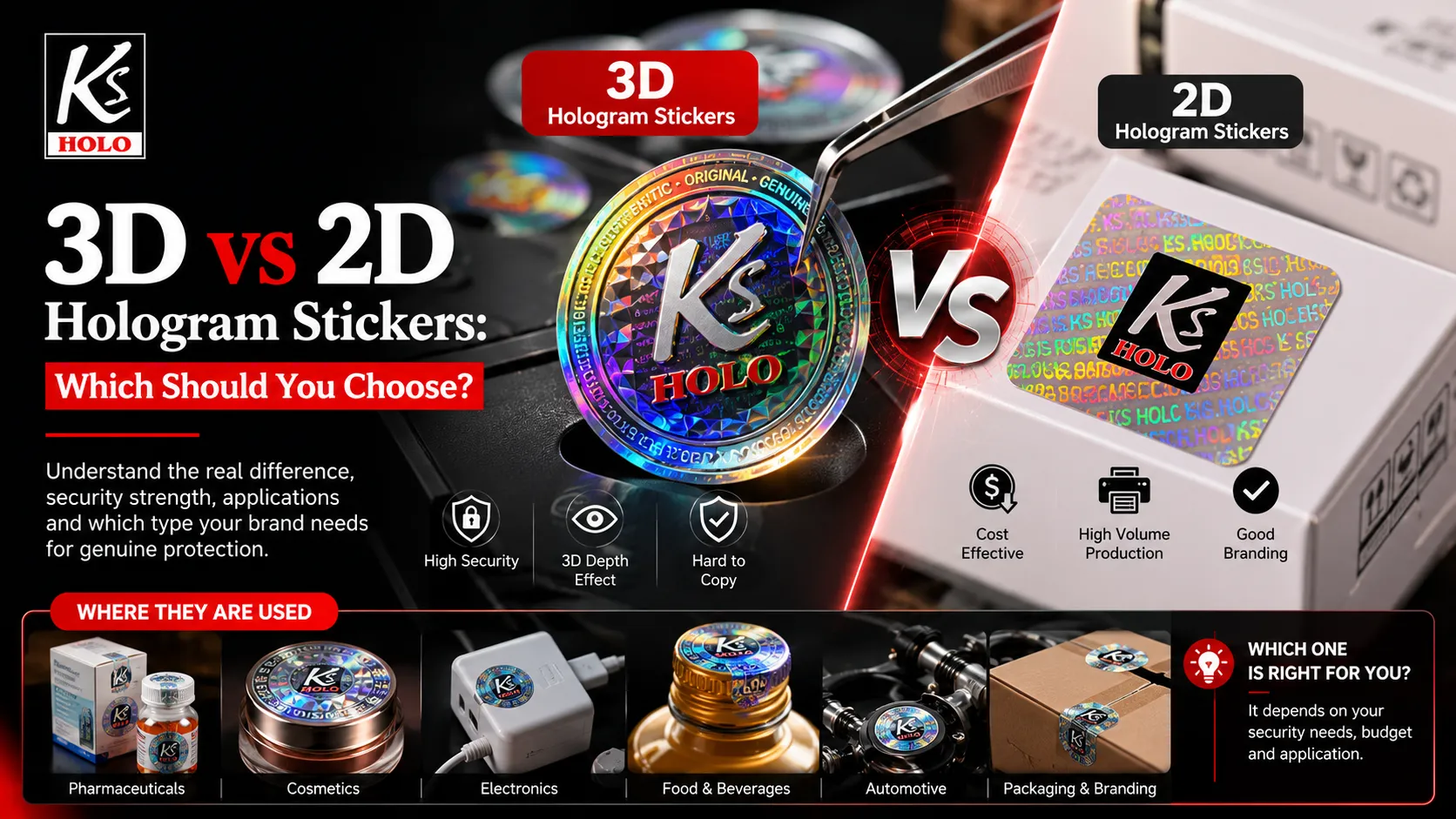
3D vs 2D Hologram Stickers: Which Should You Choose?
When sourcing hologram stickers for brand protection, most Indian procurement managers ask one question: how secure is it? The answer depends not just on whether the label is certified, but on which holographic structure you specify — and the difference between 2D and 3D hologram stickers is not cosmetic. It is structural, with direct consequences for counterfeit resistance, application suitability, and regulatory compliance. This guide sets out exactly what that means for your product category.
What Are 2D and 3D Hologram Stickers?
Both 2D and 3D hologram stickers are produced using laser interference technology — light is split, directed, and recorded onto a photosensitive medium to create a diffraction grating that produces the characteristic colour-shift effect. The critical difference lies in the number of optical planes recorded in the master hologram.
A 2D hologram contains a single optical plane. When you tilt it, the image shifts colour and appears to move, but everything in the design sits on one flat layer. A 3D hologram contains multiple depth layers — foreground, midground, and background elements are recorded at different focal planes. When tilted, the image has genuine depth, with elements shifting position relative to each other. This layered structure requires a more complex master recording process and produces an optical output that is far harder to replicate with standard equipment.
What is the difference between 2D and 3D hologram stickers?
A 2D hologram sticker has one optical plane — the pattern appears flat even when tilted. A 3D hologram sticker has multiple depth layers recorded in its master, producing a visible three-dimensional image that shifts as the viewing angle changes. This structural complexity makes 3D holograms significantly harder for counterfeiters to replicate, requiring specialised recording equipment not accessible to small-scale forgers.
For more on how holographic authentication technology works at a foundational level, read KS Holo’s What Are Hologram Security Stickers and How Do They Work?
Security Strength Comparison: 2D vs 3D Hologram Stickers
India’s Ministry of Electronics and IT has identified multi-layer optical security elements as a recommended standard for product authentication — a classification that directly supports the use of 3D holograms in sectors where counterfeiting risk is elevated. The security advantage of 3D over 2D comes down to one principle: every additional optical layer increases the cost and technical complexity of replication exponentially for any would-be counterfeiter.
A quality 2D hologram produced by an ASPA-certified manufacturer still provides strong baseline protection. The diffraction grating cannot be reproduced by any standard inkjet, offset, or laser printer. For general consumer goods at moderate counterfeiting risk — apparel tags, promotional labels, mid-range FMCG — a 2D hologram is an appropriate and cost-effective choice. The security gap between 2D and 3D becomes significant when the product category is high-value or heavily targeted.
| Feature | 2D Hologram | 3D Hologram | 3D + Covert Features |
|---|---|---|---|
| Optical planes | Single | Multi-layer | Multi-layer |
| Visible depth effect | No | Yes | Yes |
| Counterfeit difficulty | Moderate–High | High | Very High |
| Consumer self-verification | Yes | Yes (easier) | Yes (easier) |
| Covert security elements | Optional | Optional | Yes (micro-text, laser dot) |
| Typical application | FMCG, apparel, general | Pharma, electronics, export | Regulated, high-value goods |
| Cost tier | Entry | Standard | Premium |
Which Industries in India Need 3D Hologram Stickers?
The decision between 2D and 3D hologram stickers is fundamentally a risk-tier decision. ISO 12931 — the international standard for authentication elements in anti-counterfeiting measures — establishes that the security level of an authentication element must be matched to the assessed counterfeiting risk of the product category. Applying a lower-security label to a high-risk product is both a compliance gap and a commercial vulnerability.
In the Indian context, three sectors consistently demand 3D hologram stickers or higher:
- Pharmaceutical products — drug authentication requirements and the documented scale of counterfeit medicines in India make 3D the minimum effective tier for genuine brand protection
- BIS-certified electronics and consumer goods — the Standard Mark scheme requires security holograms meeting defined specifications; 3D provides the optical complexity margin that regulatory inspection and market surveillance demands
- Premium FMCG and export goods — international buyers increasingly specify 3D or multi-layer authentication in procurement contracts as a quality assurance and liability signal
General consumer goods, garment tags, and promotional materials at standard counterfeiting risk can be adequately protected with a quality 2D hologram from an ASPA-certified manufacturer.
When should Indian brands choose 3D hologram stickers over 2D?
Indian brands should choose 3D hologram stickers when their product falls into a high-counterfeiting-risk category — pharma, premium electronics, export goods, or BIS-regulated products. The multi-layer optical structure of 3D holograms raises the technical barrier to replication beyond what economically motivated counterfeiters can justify. For general consumer goods at standard risk, quality 2D holograms from ASPA-certified manufacturers remain appropriate.
ISO 12931 notes that a single authentication element — even a high-security 3D hologram — should form part of a layered security architecture for the highest-risk product categories. For brands where both physical and digital authentication are required, a 3D hologram sticker combined with a serialised QR code provides tamper evidence at the point of sale and digital track-and-trace through the supply chain — addressing both consumer-level and distributor-level verification needs.
Flat vs Embossed Hologram Labels: A Separate Dimension
When comparing holographic sticker types, buyers frequently conflate the 2D/3D dimension with the flat/embossed dimension — treating them as a single choice. They are independent. 2D vs 3D describes the optical structure recorded in the master hologram. Flat vs embossed describes the physical surface of the label substrate.
A flat hologram label has a smooth foil surface — the colour-shift effect is visible but the label has no raised texture. An embossed hologram label has a tactile pattern pressed into the foil, adding a sensory verification layer: the consumer can both see and feel the security element. These two parameters can be combined in any configuration — a 2D embossed hologram, a 3D flat hologram, or a 3D embossed hologram with covert features are all distinct and valid product specifications.
“If a hologram sticker has an embossed texture, it is automatically a 3D hologram.”
Embossing and 3D optical structure are entirely different properties of a hologram label. A 2D hologram can be embossed; a 3D hologram can be completely flat. Embossing adds a tactile dimension to consumer verification — it cannot be felt in a photocopy or a printed replica — but it does not increase the optical depth or complexity of the diffraction grating. For the highest counterfeit resistance, specify the optical tier (3D) and the surface finish (embossed or flat) as two separate parameters when briefing your manufacturer.
Custom 3D Hologram Stickers in India — What to Specify
When briefing an Indian hologram manufacturer for custom 3D hologram stickers, the specification needs to go beyond “3D hologram” to define the complete security architecture. The most critical parameters are: optical tier (2D / 3D / 3D + covert), surface treatment (flat or embossed), adhesive type (permanent / tamper-evident VOID / destructible), substrate material, label dimensions, and whether serialisation or variable data printing is required.
For brands across India — including those sourcing custom 3D hologram stickers in Delhi — ASPA membership is the baseline quality signal for any shortlisted manufacturer. ASPA-member manufacturers are subject to independent audits, minimum security specifications, and design confidentiality protocols, meaning your proprietary hologram master is protected at the production stage. KS Holo, as an ASPA founder-member and end-to-end in-house manufacturer in Delhi since 2002, supplies custom 3D hologram stickers across pharma, FMCG, electronics, and export packaging. Request a specification and free sample via WhatsApp.
The deterrence effect of a custom 3D hologram begins before it reaches the market. Counterfeiters typically assess the replication cost before targeting a product category. A custom-design 3D hologram — where the master recording is unique to your brand — means no commercially available replica master exists. Even if a counterfeiter sources blank holographic film, they cannot reproduce the specific visual identity of your approved security element without the original master.
Source: ASPA — Authentication Solution Providers’ Association, India
For a broader view of what hologram labels deliver across a brand’s supply chain, read KS Holo’s 10 Advantages of Using Hologram Labels for Your Brand.
How to Choose Between 2D and 3D Hologram Stickers: A Practical Checklist
The right hologram tier is determined by your product’s risk profile, regulatory obligations, and supply chain structure — not by budget in isolation. Use this checklist to define your starting specification before approaching a manufacturer:
- Is your product in a regulated category? (pharma, BIS-certified goods, export markets) — If yes, 3D hologram stickers are the appropriate minimum tier
- Is your product at elevated counterfeiting risk? (premium FMCG, personal care, electronics) — If yes, 3D is recommended
- Do you need tamper evidence alongside authentication? — Specify a VOID substrate as part of your brief, independent of 2D/3D tier
- Does your consumer need to self-verify without tools? — Both 2D and 3D support unaided visual verification, but 3D’s depth effect is easier for untrained consumers to confirm at the shelf
- Do you supply to international buyers who specify authentication standards? — 3D + ASPA certification meets most international procurement requirements
- Is the product general consumer goods at standard risk? — A quality ASPA-certified 2D hologram provides effective protection at entry cost
Can I upgrade from 2D to 3D hologram stickers without changing my packaging?
Yes, in most cases. If the physical dimensions, adhesive type, and application point remain the same, upgrading from a 2D to a 3D hologram sticker requires only a new master recording — your existing packaging, label artwork, and application process does not need to change. The new master is produced using your approved design, and production runs on the same substrates. Lead time for a new 3D master typically ranges from two to four weeks.
Frequently Asked Questions
What is the difference between 2D and 3D hologram stickers?
A 2D hologram sticker has a single optical plane — the pattern appears flat when tilted. A 3D hologram sticker has multiple depth layers in its master recording, producing a visible three-dimensional image that shifts as the viewing angle changes. This added structural complexity makes 3D holograms significantly more difficult for counterfeiters to replicate, requiring specialised master recording equipment not accessible to small-scale forgers.
Are 3D hologram stickers better than 2D for brand protection?
3D hologram stickers offer higher counterfeit resistance because their multi-layer optical structure requires specialised master recording equipment that cannot be economically replicated by small-scale counterfeiters. For high-risk categories — pharma, premium FMCG, and electronics — 3D is the appropriate tier. For general consumer goods at lower counterfeiting risk, a quality ASPA-certified 2D hologram provides adequate protection at lower cost.
What is the difference between flat and embossed hologram labels?
Flat hologram labels have a smooth foil surface — visual colour-shift with no raised texture. Embossed hologram labels have a tactile pattern pressed into the foil, adding a sensory verification layer a consumer can feel as well as see. Embossing is independent of the 2D/3D optical structure — a label can be 2D with embossing or 3D without. Specify both parameters separately when briefing a manufacturer.
Are 3D hologram stickers legally required for products in India?
There is no universal mandate specifying 3D hologram stickers, but regulated categories — including pharmaceutical drugs and BIS-certified products — require security holograms meeting defined specifications. The security tier required depends on the product category and regulating body. ASPA-certified manufacturers supply holograms meeting current Indian regulatory requirements across both 2D and 3D security tiers.
TL;DR — Key Takeaways
- 3D hologram stickers have multiple optical depth layers in their master recording; 2D holograms have a single flat plane — this structural difference directly determines counterfeit resistance
- Flat vs embossed is independent of 2D vs 3D — specify both separately; embossing adds a tactile verification layer but does not change the optical security tier
- ISO 12931 supports matching authentication strength to counterfeiting risk — pharma, BIS-regulated, and export goods justify 3D; general consumer goods can be served by 2D
- A custom-design 3D hologram with a unique master recording provides the strongest deterrence — no commercially available replica master means no economically viable counterfeit route
KS Holo has manufactured ASPA-certified 2D and 3D hologram stickers in India since 2002. Whether you need a standard 2D label for garment tags or a multi-layer 3D security hologram for pharma compliance, request a free specification and sample via WhatsApp or explore the full range at ksholo.com/shop.