

TL;DR
Anti-counterfeit labels pharma teams use protect pharmaceutical products by adding an easy-to-check physical authentication cue, tamper evidence, or a serialised digital link to the pack. A hologram or VOID seal does not replace GMP, regulatory labelling, or enforcement; it gives pharmacists, distributors, and patients a faster reason to question a suspicious pack.
DEFINITION
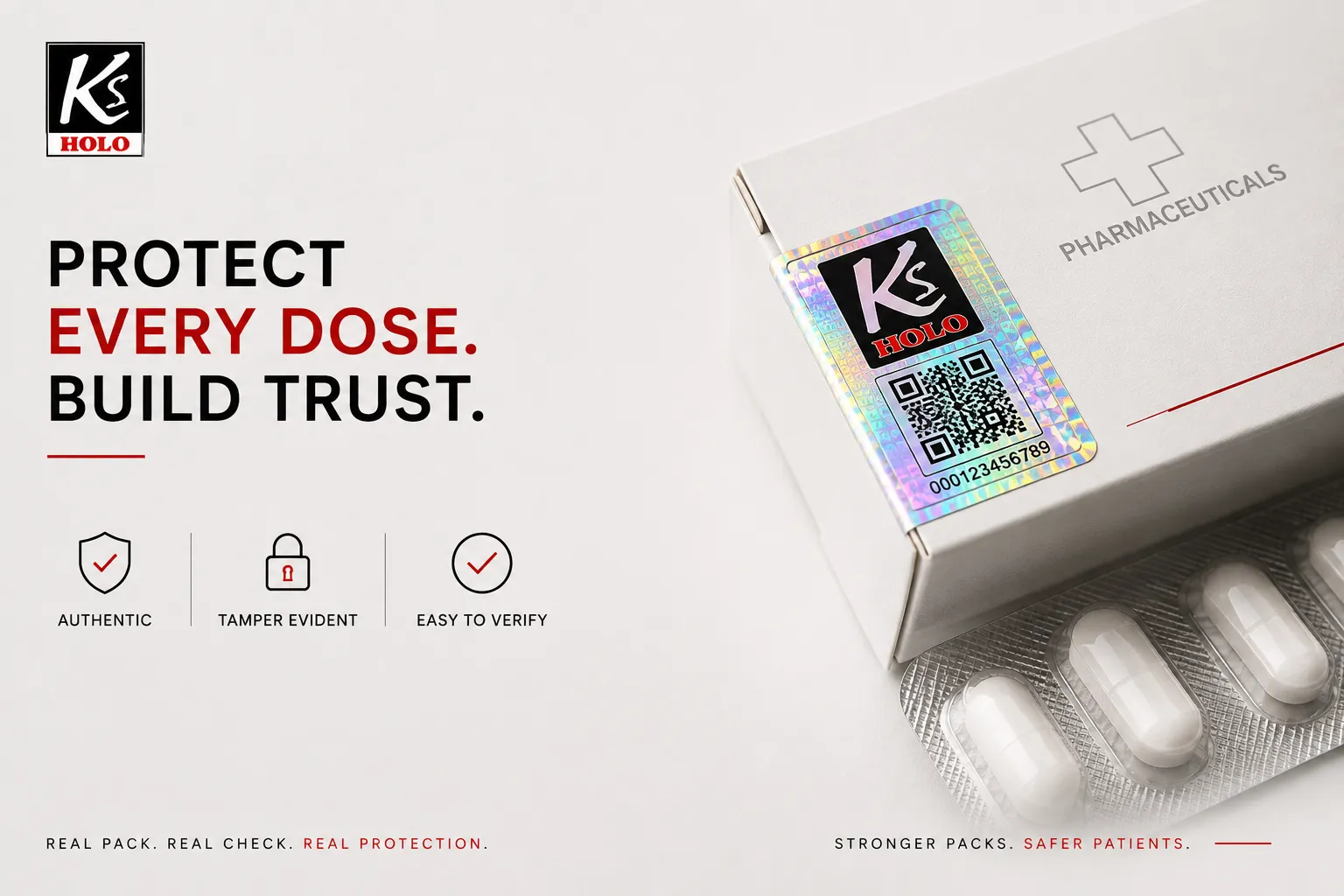
Definition — Anti-counterfeit labels for pharmaceutical products are purpose-designed security labels applied to a carton, blister, bottle, or secondary pack to help establish identity and reveal interference. They may combine diffractive holographic effects, tamper-evident adhesives, micro-text, serial numbers, and QR codes so that visual authentication and traceability work together.
When a medicine pack is copied convincingly, the danger is not merely lost sales. A patient may receive the wrong active ingredient, wrong dose, or no therapeutic value. WHO notes that substandard and falsified medical products can contribute to treatment failure and antimicrobial resistance, and are often sold online or through informal markets. The OECD/EUIPO’s 2025 analysis also estimates counterfeits and pirated goods at up to 2.3% of global trade. This makes anti-counterfeit labels pharma teams specify a practical part of medical product security, not an ornamental finish.
EVIDENCE
WHO’s current fact sheet says that at least 1 in 10 medicines in low- and middle-income countries are substandard or falsified. The figure covers both quality failures and deliberate falsification, so it should not be read as a count of counterfeit labels alone.
What anti-counterfeit labels do on a pharmaceutical pack
The most useful label sits where someone can inspect it before supply or dispensing: the folding carton closure, bottle cap and shoulder, blister wallet, or shipper seal. It gives the pack a visible identity feature and, where required, proof that the package has been opened.
How do pharma hologram stickers protect a medicine pack?
QUICK ANSWER
Pharma hologram stickers protect a medicine pack by presenting a registered optical feature that changes with viewing angle and is difficult to reproduce with ordinary print. Placed on a carton or bottle, they help a pharmacist or distributor compare the pack with an approved genuine sample; a tamper-evident version also leaves a visible sign if it is removed.
Three jobs should be kept distinct when choosing a label:
- Authenticate — help a person recognise a genuine product through a hologram, registered artwork, or micro-feature.
- Indicate tampering — show that a closure, carton flap, or bottle cap was lifted, opened, or resealed.
- Connect to records — route a serial or QR code to a controlled verification or traceability system.
This distinction matters because a plain QR code can be copied onto a fake carton, while a generic shiny sticker may offer little controlled authentication. For a concise primer on optical features, see What Are Hologram Security Stickers and How Do They Work?.
MYTH
“A hologram alone proves that a medicine is genuine.”
REALITY
A hologram is one physical layer, not a laboratory test or a complete track-and-trace programme. Its value rises when registered artwork, controlled supply, a fixed placement rule, and a distributor verification process make cloning and resealing more difficult to hide.
Choosing the right drug authentication label
The right construction depends on the pack format and threat. A hologram sticker for a medicine bottle must tolerate its substrate, curvature, handling, and applicable storage conditions. A carton closure may need a VOID transfer pattern instead. The label should never obscure mandatory information.
| Label type | Primary purpose | Best placement | Main limitation |
|---|---|---|---|
| Custom security hologram | Visual authentication | Carton face, bottle label, blister wallet | Does not itself show a pack was opened |
| VOID hologram seal | Tamper indication + authentication | Carton flap, bottle cap, secondary pack | Needs substrate and adhesive testing |
| Destructible label | One-time closure evidence | Carton flap, small closures | Less useful as a consumer-facing authentication cue |
| QR + hologram hybrid | Physical check + digital lookup | Secondary carton or leaflet area | Requires secure serial and response workflow |
What is the difference between a medicine packaging hologram and a VOID label?
QUICK ANSWER
A medicine packaging hologram mainly helps someone recognise the authorised pack through optical effects and registered design. A VOID label is engineered to change, fragment, or leave a residual message when lifted, making unauthorised opening or resealing visible. High-risk secondary packs often use both functions in one controlled seal.
For pharmaceutical cartons that must show opening, a VOID construction is usually more relevant than decorative film. The adhesive, release pattern, label size, and seal position need a trial on the real board and varnish. Our guide to How Tamper-Evident VOID Labels Enhance Product Security explains why the residual pattern and application surface matter.
DID YOU KNOW?
The 2025 ASPA-CRISIL consumer study reported that counterfeit medicines accounted for around 28% of the pharmaceutical market perceived by respondents; the study covered 1,639 respondents across nine Indian cities.
Source: Pharmabiz reporting on the ASPA-CRISIL State of Counterfeiting in India 2025 report
Indian regulatory context: labels, the Drugs Act, and QR codes
Drug authentication labels are a supporting security layer, not a replacement for statutory drug labelling. The Drugs and Cosmetics Act, 1940 treats a drug as spurious when it imitates or resembles another drug in a manner likely to deceive. The Drugs Rules, 1945 require prescribed particulars on the innermost container and every other covering.
For the notified top 300 drug formulations, CDSCO’s FAQ says manufacturers must print or affix a barcode or QR code carrying specified particulars, including product identification, drug and brand names, manufacturer details, batch number, dates, and licence number. It took effect on 1 August 2023. That is not a blanket mandate for hologram stickers on every drug in India.
EVIDENCE
CDSCO confirms that the barcode/QR-code mandate applies to the 300 formulations named in Schedule H2. It also says that, if space is inadequate on primary packaging, the code may be printed or affixed on the secondary package label.
EXPERT OPINION
“Counterfeiting incidents have increased over the past three years, with counterfeiters becoming increasingly sophisticated and better funded.”
— Ankit Gupta, President, ASPA, quoted in reporting on the ASPA-CRISIL 2025 study
Source: Pharmabiz
Regulatory, QA, packaging, and brand-protection teams should agree on mandatory pack information, voluntary security features, and who validates each stage. That prevents a medicine packaging hologram India programme from being treated as a substitute for compliance review.
A layered anti-counterfeit plan for pharma brands
No single label can stop every counterfeit route. A defensible programme uses a hard-to-copy physical signal, tamper evidence where relevant, controlled artwork, and digital authentication only when the brand can respond to exceptions.
What anti-counterfeit measures do pharma companies use?
QUICK ANSWER
Pharma companies commonly combine compliant package labelling with serial or QR identification, security holograms, tamper-evident VOID or destructible seals, distributor training, complaint handling, and marketplace or enforcement action. The appropriate mix depends on the product’s risk, pack format, channel exposure, and the brand’s capacity to manage verification data and investigations.
STEP-BY-STEP
- Map the risk — identify products, pack formats, channels, and complaint patterns most exposed to diversion or copying.
- Choose the verification moment — decide whether a line operator, distributor, pharmacist, or patient needs to check the pack.
- Specify the physical layer — select custom hologram, VOID construction, or destructible seal; test it on the real carton, bottle, or blister material.
- Add the digital layer deliberately — use QR or serialisation only with ownership of the code data, verification screen, and escalation procedure.
- Control artwork and supply — approve masters, store production files securely, and keep batch continuity records.
- Train and review — give channel teams a genuine-pack reference and investigate repeat anomalies by location or batch.
| Risk signal | Recommended label approach | Operational control |
|---|---|---|
| Copied carton graphics | Registered pharma hologram stickers | Approved master + visual reference sample |
| Opened or resealed carton | VOID or destructible closure seal | Fixed seal position in packaging SOP |
| High-value bottle or vial | Hologram sticker for medicine bottle + cap integrity | Adhesion and storage-condition validation |
| Need for record lookup | QR + physical security label | Serial governance and exception handling |
FIRST-HAND EXPERIENCE
From security-label production conversations with Indian pharmaceutical packaging teams, the practical question is rarely “Which label looks premium?” It is “Who must reject a suspect pack, and what can they reliably see?” Carton flaps and bottle closures therefore receive as much attention as hologram artwork. KS Holo has manufactured holograms and labels in Delhi since 2002 and is an ASPA founder-member; the brief starts with the substrate and check point.
For teams deciding between overt visual impact and a more controlled construction, 3D vs 2D Hologram Stickers: Which Should You Choose? is a useful design comparison. A pharma label manufacturer Delhi should then provide samples on the actual pharmaceutical pack material before the specification is frozen.
If your team needs to evaluate seal placement, adhesion, VOID transfer, or a QR-plus-hologram concept on a live carton or bottle, request a controlled sample discussion with KS Holo on WhatsApp.
Frequently Asked Questions
How are hologram labels used on medicine packaging in India?
QUICK ANSWER
In India, hologram labels are commonly used as voluntary physical authentication features on medicine cartons, bottle labels, blister wallets, and secondary packs. They are usually placed where a distributor, pharmacist, or patient can see a registered optical effect. Where opening needs to be visible, brands use a hologram with a VOID or destructible tamper-evident construction.
Are hologram stickers mandatory on drugs in India?
QUICK ANSWER
No universal Indian rule makes hologram stickers mandatory on every drug. The Drugs Rules prescribe labelling particulars, and CDSCO requires a barcode or QR code for the notified 300 formulations in Schedule H2. A hologram can support brand protection and pack authentication, but the regulatory team should confirm the obligations for the specific product and pack.
Can a QR code replace a counterfeit drugs sticker on a medicine carton?
QUICK ANSWER
Not by itself. A QR code enables a digital lookup, but it can be copied and reprinted unless the code, data, and verification response are governed securely. Pairing a QR code with a physical anti-counterfeit feature such as a registered hologram or a tamper-evident label gives the checker both a visible cue and a digital route.
What should I test before using a hologram sticker for a medicine bottle?
QUICK ANSWER
Test adhesion on the actual bottle material and curvature, label position, rub resistance, removal behaviour, and compatibility with expected storage and handling. Also check that the hologram sticker does not cover mandatory text, batch details, or a regulatory barcode/QR code. A sample trial on the finished pack is more reliable than selecting from a film sample alone.
Should a pharma company use a VOID seal or a 3D hologram on secondary packaging?
QUICK ANSWER
Choose a VOID seal when the main requirement is evidence that a carton or closure was opened or resealed. Choose a custom 3D or 2D hologram when a visible authenticity cue is the priority. Many counterfeit-prone pharmaceutical packs combine the two functions, provided the seal is tested on the carton board and supports the line’s application process.
QUICK SUMMARY
Do anti-counterfeit labels help protect pharmaceutical products in India?
Yes, when they are one part of a controlled packaging and verification programme.
A quality anti-counterfeit label programme can:
- ✓ Add a hard-to-copy visual authentication cue to cartons or bottles
- ✓ Show tampering with VOID or destructible constructions
- ✓ Complement regulated QR/barcode data and distributor checks
- ✓ Give packaging teams a defined suspect-pack escalation point
It cannot replace:
- ✗ Drugs Act and Drugs Rules compliance
- ✗ GMP, quality testing, and authorised distribution controls
- ✗ Investigation, enforcement, or a secure serial-data workflow
Sources
- WHO — Substandard and falsified medical products
- CDSCO — Drugs and Cosmetics Act, 1940 and Drugs Rules, 1945
- CDSCO — FAQs on implementation of G.S.R. 823(E) for barcodes/QR codes
- Pharmabiz — ASPA-CRISIL State of Counterfeiting in India 2025 report coverage
- OECD/EUIPO — Mapping Global Trade in Fakes 2025