

TL;DR
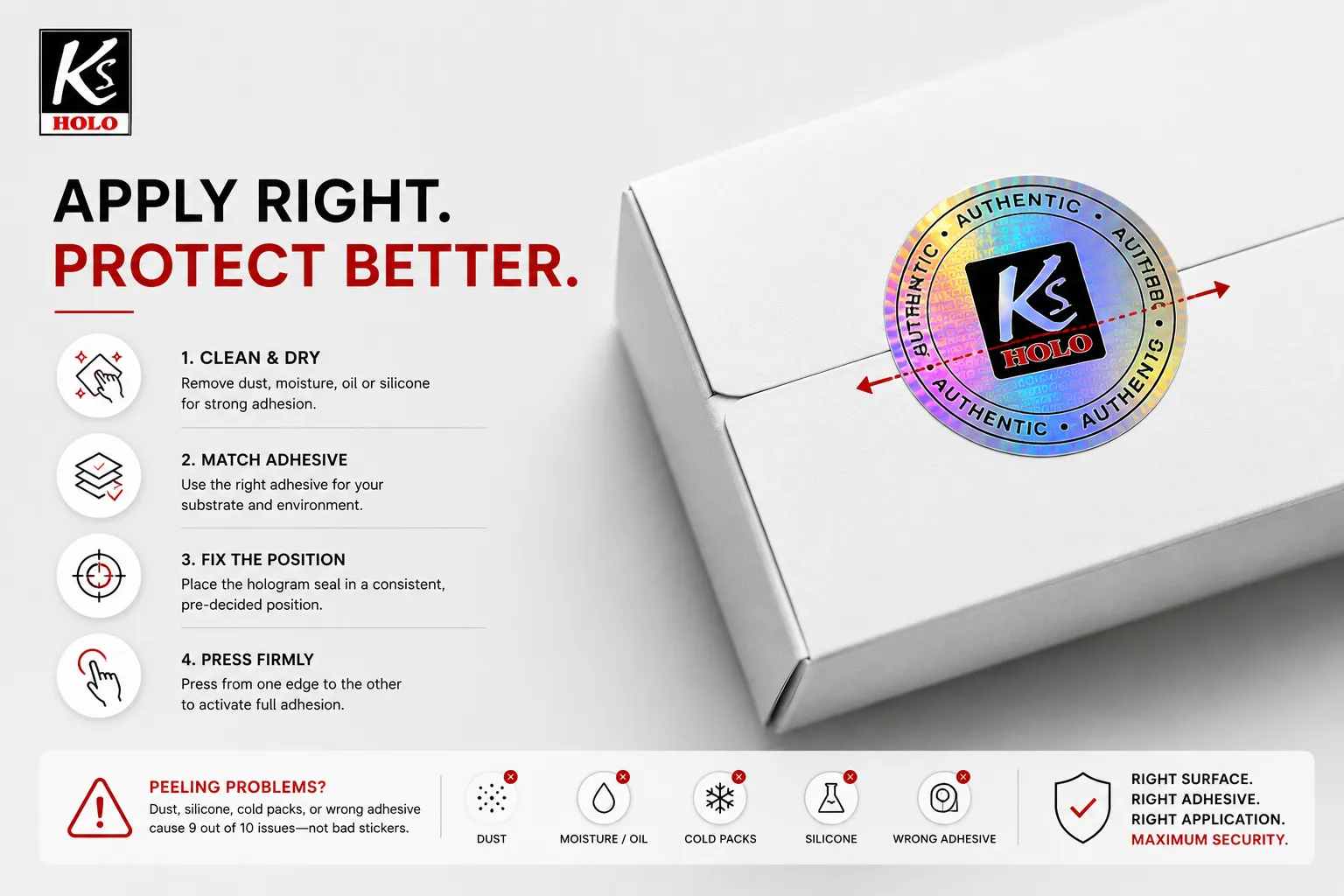
To apply hologram stickers correctly, clean and dry the surface, match adhesive to the substrate, place the seal in a fixed position, and press firmly from one edge to the other. Most hologram label peeling problems come from dust, silicone, cold packs, or wrong adhesive—not from “bad stickers.”
DEFINITION
Definition — Applying hologram stickers is the controlled process of transferring a pressure-sensitive holographic security label onto packaging or a product surface so the seal bonds fully, stays readable, and—where specified—shows tamper evidence if lifted; correct application covers surface prep, placement, pressure, cure time, and line training.
A hologram only protects the pack if it stays where operations put it. In India, physical seals still matter because many buyers verify with their eyes first. Coverage of the ASPA–Accenture authentication and traceability study notes that India’s A&T market still relies heavily on physical technologies such as holograms, security inks, and labels—especially where digital checks are harder to run. That makes apply hologram stickers discipline a brand-protection step, not a packing afterthought.
EVIDENCE
ISO/TS 18614:2016 gives guidelines for requesting and specifying self-adhesive label materials, including what to communicate about the intended application, surface, and use conditions—so adhesion problems are often a specification gap, not only an operator error.
Source: ISO/TS 18614:2016
How do you apply a hologram sticker so it does not peel?
How do you apply a hologram sticker so it does not peel?
QUICK ANSWER
Apply a hologram sticker so it does not peel by cleaning the surface, confirming the pack is dry and above the adhesive’s application temperature, positioning the seal once, and pressing firmly edge-to-edge without trapping air. Do not touch the adhesive. Allow time for bond strength to build before rough handling or heat shrink stress.
QUOTABLE SPECS — how to apply hologram stickers
| Surface prep | Clean with ~70% isopropyl alcohol (or approved evaporative cleaner); spot-test finishes; wipe fully dry |
| Application temperature | Typically 15–30°C (59–86°F) for pack and label; avoid cold-store packs straight to apply |
| Full bond / cure window | Initial tack is immediate; plan on about 24–48 hours toward full pressure-sensitive strength |
| Reposition rule | No reposition after tack on VOID/destructible seals — scrap and re-apply |
| Pressure method | Place one edge first; firm thumb or soft roller edge-to-edge; avoid hard tools on adhesive face |
| India climate note | Monsoon humidity and AC-chilled packs are common peel drivers — condition stock and dry the seal zone |
Confirm exact film, adhesive, and die on a pack sample before freezing the PO — values above are typical manufacturing ranges used for quoting, not a universal guarantee.
STEP-BY-STEP
- Condition stock and packs — store labels sealed; let labels and packs sit in the same room before use.
- Prep the surface — wipe dust, oil, wax, release agent, or soft-touch overspray from the seal zone.
- Dry completely — moisture and solvent residue both cause early lift.
- Peel liner carefully — hold edges; keep fingers off the adhesive face.
- Place once — align to the mark or jig; avoid slide-and-stretch on small dies.
- Press edge to edge — firm thumb or soft roller; push air out, do not rub circles that wrinkle film.
- Second pass — press again after a few seconds, especially on curves and flap joins.
- Cure before stress — avoid stacking abrasion, shrink tunnels, or aggressive wipe-downs until the bond has set.
PRE-TRIGGER VOID CONTROL
Tamper-evident holograms can show VOID/dot patterns if the adhesive face is mishandled during application. Prevent false “failures”:
- Flag method — peel a corner of the liner, tack that edge to the pack, then pull the rest of the liner away.
- Minimise adhesive contact time — do not park the sticky face on dry fingers.
- No hard tools on adhesive — avoid knife blades, tweezers, or dry plastic tips that pre-trigger release patterns.
- Soft handling aids — rubber fingertips (smooth side) or light skin moisture on the transfer finger if manual peel is required.
- One-way rule — if VOID appears after a botched place, scrap the seal; do not restick.
Do’s and don’ts when installing a hologram label
Do
- Fix one label placement stickers position for every SKU and train to that mark.
- Match adhesive to carton board, BOPP, PET, glass, or metal before scale-up.
- Sample how to stick hologram label properly on the real varnish or soft-touch finish.
- Use a jig or printed guide mark for high-volume lines.
- Treat void seals as one-way: a correct tamper label apply leaves evidence if lifted.
Don’t
- Apply over dust, fingerprints, silicone, or wet ink.
- Stretch the film around sharp corners to “make it fit.”
- Reposition a void hologram after first contact.
- Store open rolls in heat, humidity, or direct sun.
- Assume one adhesive works on every substrate across the catalogue.
If you need the security logic behind optical seals before writing the SOP, start with What Are Hologram Security Stickers and How Do They Work?.
MYTH
“If a hologram peels, the sticker quality is always poor.”
REALITY
Most early peel comes from surface contamination, low application temperature, curved low-energy plastics, or an adhesive not specified for that finish. Test the real pack before blaming the hologram stock.
What surfaces are hologram stickers compatible with?
What surfaces are hologram stickers compatible with?
QUICK ANSWER
Hologram stickers are commonly compatible with paperboard cartons, many plastics, glass, and coated metals when the adhesive and face stock are chosen for that surface. Compatibility is not universal: soft-touch coatings, oily films, heavy silicone release, frost, and extreme curves need trials. Always validate surface prep for hologram sticker programmes on production packs.
| Surface / pack type | Usually works when… | Watch-outs |
|---|---|---|
| Folding carton / SBS | Clean dry board, correct adhesive | Soft-touch, heavy varnish, dust from cutting |
| BOPP / PET pouches | Film-grade adhesive, firm pressure | Slip agents, low dyne, wrinkles |
| Glass bottles / jars | Clean dry glass, neck or shoulder flat enough | Condensation, curved mini necks |
| Plastic jars / devices | Substrate-matched adhesive | Polyolefins, mould release, textured lids |
| Metal tins / cans | Degreased metal, tested adhesive | Oil films, sharp seams |
DID YOU KNOW?
Coverage of ASPA’s authentication work with Accenture notes that physical seals remain especially relevant where a large share of consumption is still rural—so a seal that fails to stick in real packing conditions undermines the whole authentication layer.
Source: Packaging South Asia — ASPA & Accenture A&T study coverage
Why is my hologram label not sticking?
Why is my hologram label not sticking?
QUICK ANSWER
A hologram label is usually not sticking because the surface is contaminated, too cold, too curved, still wet, or finished with a low-energy coating the adhesive was not built for. Operator haste—touching adhesive, trapping air, or repositioning—also causes lift. Diagnose substrate and process before changing suppliers.
Common hologram label peeling problem checks:
- Contamination — powder, hand lotion, carton dust, mould release.
- Temperature — cold stores and AC-chilled packs below adhesive window.
- Moisture — condensation on glass or bottles from chillers.
- Geometry — tiny seals forced over ridges, seams, or deep curves.
- Wrong construction — permanent authentication sticker vs void seal used like a repositionable decal.
- Cure ignored — packs scuffed or shrink-wrapped seconds after apply.
| Symptom | Likely cause | First fix |
|---|---|---|
| Corner lift in hours | Dust, soft-touch, weak pressure | Clean zone; re-press; re-sample adhesive |
| Full lift in cold chain | Application below adhesive range | Warm packs/labels; change adhesive grade |
| Bubbles / tunnels | Air trapped; wrinkled film | Edge-to-edge press; slower hand apply |
| Tears on removal (unexpected) | Void/destruct design working as built | Train staff: void seals are not reusable |
| Lift only on one SKU | Finish or geometry unique to that pack | Substrate-specific trial, not line-wide blame |
For seals that must show opening, How Tamper-Evident VOID Labels Enhance Product Security explains why residual patterns and application surface both matter.
EXPERT OPINION
“Physical security measures such as tamper-evident labels, security holograms, RFID-enabled smart packaging, and covert machine-readable markers provide multi-layered protection.”
— Manoj Kochar, President, ASPA (interviewed in The Packman on authentication ecosystems in Indian packaging)
Source: The Packman
Indian context: line SOPs, climate, and channel checks
Hologram sticker application tips India teams need are practical: dust from carton cutting, monsoon humidity, cold-chain condensation, and soft-touch boards popular on FMCG and beauty packs. A seal that looks perfect in a Delhi sample room can lift in a humid packing shed if surface prep is skipped.
Authentication only works if the physical layer survives packing and distribution. ASPA guidance on authentication solutions stresses that selecting and properly implementing the right technologies—and the right vendor practices—drives long-term benefit for brand owners. Application SOP is part of that implementation.
| Line condition (India) | Risk to adhesion | Practical control |
|---|---|---|
| Monsoon humidity | Moisture under seal | Dry packs; sealed label storage |
| Soft-touch / matte luxury cartons | Early corner peel | Substrate trial before MOQ |
| Cold room / pharma logistics | Cold-surface fail | Warm-up window; adhesive grade |
| High-speed manual apply | Misplacement, air traps | Jig + photo SOP card |
| Multi-vendor packing | Inconsistent prep | One written SOP + sample retain |
FIRST-HAND EXPERIENCE
In Indian packing lines, most “sticker complaints” we see are process complaints: soft-touch varnish never disclosed, operators repositioning void seals, or labels applied straight from a hot vehicle onto chilled bottles. KS Holo has manufactured security holograms and labels in India since 2002 as an ASPA founder-member with end-to-end in-house production; application briefs start with the real pack finish and who presses the seal—not only artwork.
| Checklist item | Pass signal | Fail signal |
|---|---|---|
| Surface prep | Clean dry zone | Visible dust/oil |
| Placement | Same corner every pack | Drift across batch |
| Pressure | No air tunnels | Bubbles, lifted edges |
| Void behaviour | Residual on intentional lift test | Peels clean like a decal |
| After 24–72 h | Still flat after handling | Corner lift in transit |
When adhesive grade, void construction, or a packing-line sample needs review, request a substrate check with KS Holo on WhatsApp. For vendor capability questions beyond application, use How to Choose a Hologram Label Manufacturer: 5 Key Questions.
Frequently Asked Questions
Can I reposition a hologram after the adhesive touches the carton?
QUICK ANSWER
Usually no—especially with void or destructible constructions. First contact starts the bond and may trigger tamper evidence. If alignment is wrong, remove and scrap that seal, clean the area, and apply a new label. Build placement guides so operators rarely need a second try.
How long before a hologram reaches full stick strength?
QUICK ANSWER
Initial tack is immediate, but pressure-sensitive adhesives typically build toward full bond over about 24–48 hours depending on adhesive, temperature, and substrate. Keep application near 15–30°C. Avoid rough handling, aggressive wiping, or shrink stress in the early window. Confirm cure expectations when you approve the sample.
Should I use isopropyl alcohol for surface prep for hologram sticker zones?
QUICK ANSWER
Use about 70% isopropyl alcohol (or an approved evaporative cleaner) on many packaging surfaces, but always spot-test finishes first—some inks, soft-touch coats, and plastics mark or haze. Wipe dry before apply. Never leave a wet film under the seal.
Do automatic applicators change how to stick hologram label properly?
QUICK ANSWER
The principles stay the same—clean surface, correct adhesive, accurate placement, firm wipe-down—but machine speed, peel-plate setup, and pack presentation become critical. Validate applicator settings on the live carton and keep spare seals for manual rework without changing placement rules.
Why do void holograms “fail” when staff peel and restick them?
QUICK ANSWER
They are working as designed. Void and destructible seals are meant to show interference. Retraining is the fix: authentication seals are not reusable decals. If you need a temporary process label, use a different construction for that job.
What should I send a manufacturer when adhesion keeps failing on one SKU?
QUICK ANSWER
Send pack samples or clear photos of the finish, die size, apply temperature, peel timing, and where lift starts. Note varnish, soft-touch, film type, and whether packs come from cold storage. A short substrate trial beats guessing adhesive from a catalogue swatch.
QUICK SUMMARY
Do brands need a written process to apply hologram stickers correctly?
Yes—if the seal is meant to authenticate packs in real distribution.
A disciplined application SOP can:
- ✓ Reduce peel and air-bubble rejects
- ✓ Keep label placement consistent for channel checks
- ✓ Preserve void / tamper evidence as designed
- ✓ Match adhesive to real Indian pack finishes
It cannot replace:
- ✗ Choosing the right adhesive and construction up front
- ✗ Controlled artwork and genuine seal supply
- ✗ Training that treats security seals as one-way devices
Sources
- ISO/TS 18614:2016 — Packaging: required information for ordering and specifying self-adhesive labels
- Packaging South Asia — ASPA & Accenture Indian Authentication & Traceability study coverage
- The Packman — ASPA roadmap interview with Manoj Kochar
- ASPA — Authentication solutions overview
- ICC BASCAP — Business Action to Stop Counterfeiting and Piracy
- KS Holo