

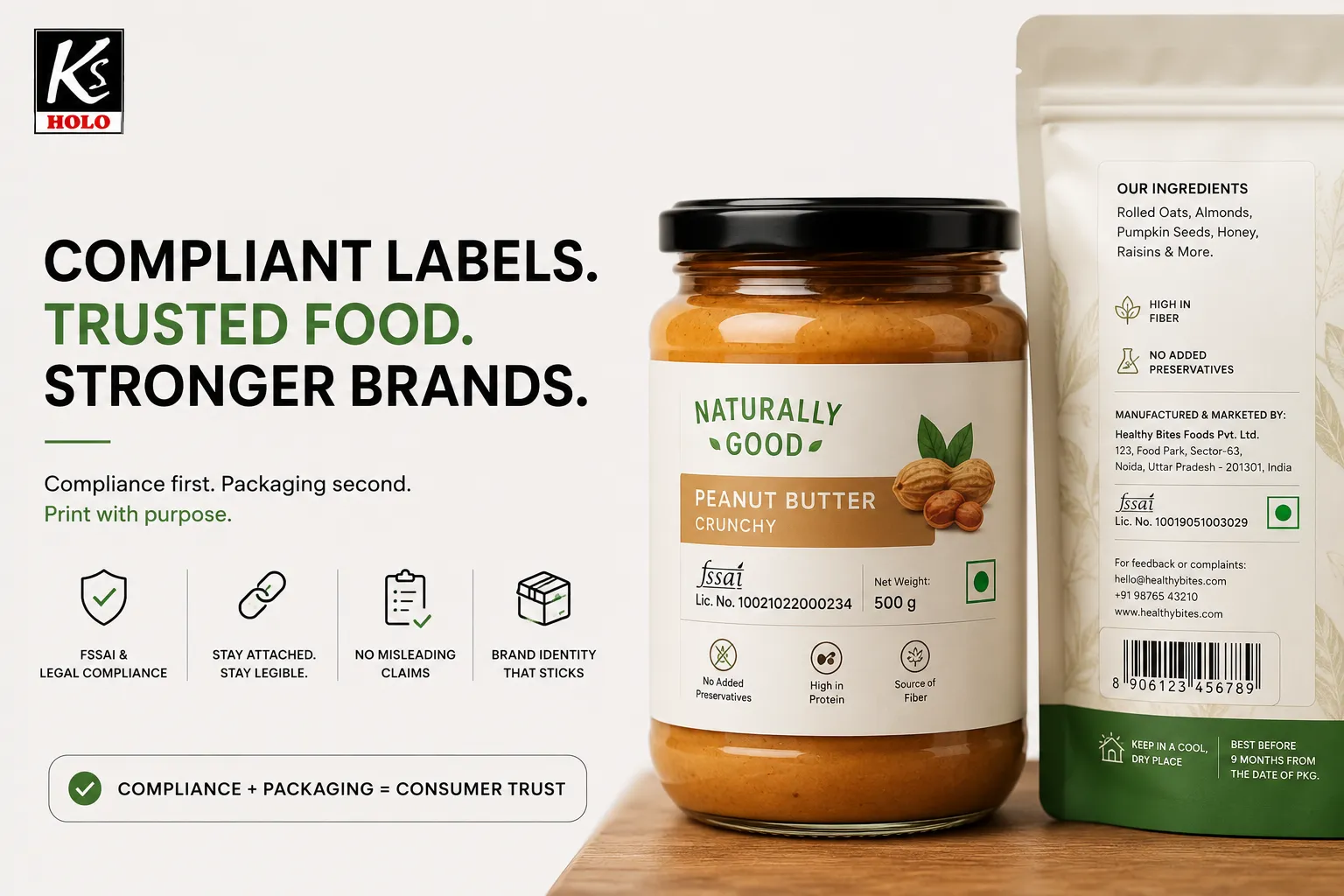
Custom Printed Labels for Food & Beverage Products in India
TL;DR
Food product labels India brands need must carry mandatory FSSAI and related declarations, stay attached and legible, and avoid misleading claims. Custom printed jar and pouch stickers then add brand identity. Treat label design as compliance plus packaging—not artwork alone—before you print a full run.
DEFINITION
Definition — Food product labels in India are the printed stickers or panels on pre-packaged foods and beverages that display mandatory information (such as product identity, ingredients, nutrition, veg/non-veg mark, FSSAI logo and licence details, dates, and net quantity) together with brand graphics; custom food label printing means producing those declarations and designs on stocks suited to jars, bottles, pouches, and cartons.
A beautiful pack with a weak label is a retail and regulatory risk. Trade reporting has repeatedly shown that mislabelling and claim problems are not niche issues: The Tribune notes FSSAI-linked data indicating that nearly half of penalties in the food sector have been associated with mislabelling. That is why food product labels India programmes succeed when compliance copy, finish, and adhesive are locked together—before a custom food label printer runs volume.
EVIDENCE
Reporting in The Tribune on packaged-food mislabelling states that FSSAI data shows nearly half of all penalties issued in the food sector are linked to mislabelling—underscoring why label content and claims deserve the same scrutiny as recipes and costing.
Source: The Tribune
What information must be on a food product label in India?
What information must be on a food product label in India?
QUICK ANSWER
A typical retail food product label in India must show the true name of the food, ingredient list, nutritional information, vegetarian or non-vegetarian declaration, brand-owner details, FSSAI logo and licence number(s), batch/lot and date marking, and net quantity—plus other category-specific declarations where applicable. Claims on the pack must not mislead. Exact layouts depend on pack size and product type, so confirm against current FSSAI rules for your SKU.
Core FSSAI label requirements most packaged F&B brands plan for:
- Name of the food — indicating the true nature of what is inside.
- Ingredient list — usually in descending order of weight or volume.
- Nutritional information — as required for the product category.
- Veg / non-veg symbol — correctly sized and placed.
- FSSAI logo and licence number — brand owner (and other licence numbers if required when entities differ).
- Date marking and lot/batch — manufacture/pack and best-before or use-by as applicable.
- Net quantity — aligned with packaged-commodity rules for retail sale.
FSSAI’s Labelling & Display FAQs also clarify practical points brands miss in artwork—such as displaying the FSSAI logo and licence number in a colour that contrasts with the label background.
Retail packs also sit under Legal Metrology packaged-commodity declarations. The Department of Consumer Affairs overview summarises mandatory declarations on packages, including manufacturer/packer/importer identity, commodity name, net quantity, month/year of manufacture or pack/import, MRP form where applicable, and consumer care details.
| Declaration cluster | Typical home | Common print mistake |
|---|---|---|
| Product identity + claims | Front / billboard | Marketing line that overstates the food |
| Ingredients + nutrition | Information panel | Tiny type; wrong ingredient order |
| FSSAI logo + licence | Contrast area on label | Low-contrast logo; outdated licence |
| Dates + lot | Side / rear | Missing batch; ambiguous date format |
| Net quantity + MRP cues | Principal / info panel | Unit symbols or placement errors |
MYTH
"If the back panel has nutrition and ingredients, bold front claims can say anything."
REALITY
Front-of-pack words are part of the label. Regulators have been scrutinising terms that create a misleading impression. Business Standard reports brands rewriting packs after notices on words such as “healthy,” “natural,” “fresh,” and “100%.”
How do I get custom labels for my food brand?
How do I get custom labels for my food brand?
QUICK ANSWER
Get custom labels for a food brand by locking compliant copy first, choosing stock and finish for the pack, then working with a custom food label manufacturer on proofs and a jar or pouch trial. Approve FSSAI and Legal Metrology declarations with your compliance owner before mass jar label printing India runs. Print only after licence numbers and claims are final.
STEP-BY-STEP
- Freeze the product facts — recipe weights, allergens, nutrition basis, veg/non-veg status.
- Draft mandatory copy — name, ingredients, nutrition, licence, dates, net quantity, care line.
- Stress-test claims — remove or substantiate “healthy,” “natural,” “100%,” and similar lines.
- Choose stock and finish — paper matte/gloss/kraft or film where moisture demands it.
- Share dielines and pack photos with your printer — jar curve, pouch film, carton face.
- Proof for contrast and size — FSSAI logo contrast, veg symbol size, smallest text.
- Trial apply on real packs — chill, oil, and abrasion checks before the full order.
| Stage | Owner | Output |
|---|---|---|
| Compliance draft | Brand + QA / consultant | Locked text block |
| Visual design | Brand / agency | Hierarchy without hiding declarations |
| Print engineering | Custom food label manufacturer Delhi / printer | Stock, adhesive, die, finish |
| Line trial | Operations | Apply SOP + retain samples |
Industry guides for startups repeatedly warn against treating labelling as a last-minute design task. Practical write-ups such as Fairlabs’ food-labelling guide for startups emphasise validating declarations before artwork is “final”—especially licence numbers, ingredient order, allergens, and unsupported claims.
If your food pack also needs a tamper cue on cartons or closures, How Tamper-Evident VOID Labels Enhance Product Security explains residual seals that show opening.
DID YOU KNOW?
Mint reporting on FSSAI’s tighter scrutiny of health and nutrition claims notes that in a Mint survey of about 50 respondents, 90% said they had bought a packaged food product because of a health claim on the label—showing why claim language on a food packaging sticker is commercially powerful and regulatorily sensitive.
Source: Mint
Are paper labels safe for food packaging?
Are paper labels safe for food packaging?
QUICK ANSWER
Paper labels are widely used and can be appropriate for food packaging when the overall pack system is suitable for the product—adhesive, coating, and any food-contact layers must fit the use case. A printed sticker for a food brand India launch is “safe” in practice when it stays attached, remains legible, does not contaminate the product pathway, and does not hide or replace mandatory declarations. Direct food-contact situations need stricter material controls than outer jar wraps.
Practical safety and fitness checks for FSSAI compliant label printing:
- Outer labels on sealed jars/bottles — common paper stocks with tested adhesives.
- Oily / chilled products — confirm edge lift and condensation behaviour.
- Direct contact or liners — do not assume decorative paper stock is automatically food-contact graded.
- Ink and varnish — keep declarations indelible under normal handling.
- Separation risk — labels that peel defeat both shoppers and inspectors.
| Use case | Paper label usually OK? | Extra check |
|---|---|---|
| Dry spice jar wrap | Yes, often | Abrasion in transit |
| Oil / ghee / pickle jar | Maybe | Oil + adhesive trial |
| Cold beverage bottle | Maybe | Condensation window |
| Inner liner touching food | Not by default | Food-contact specification |
| Secondary carton sticker | Yes, often | Placement vs barcode |
For authenticity layers beyond paper branding—especially where lookalike packs appear in wholesale markets—see Hologram Manufacturer: Your 2026 Guide to Securing Brands Against Counterfeits.
EXPERT OPINION
“Claims around ‘no added sugar,’ ‘zero sugar,’ ‘naturally sweet’ and ‘no refined sugar’ top the list. Then come ‘high protein,’ ‘natural,’ ‘clean label’, organic claims, and gut health and immunity.”
— Ashwin Bhadri, Founder and CEO, Equinox Labs (quoted in Mint on categories dominating compliance conversations)
Source: Mint
Indian context: D2C food brands, claims crackdowns, and Delhi printing
Indian D2C sauces, snacks, beverages, and wellness foods scale fast on marketplaces—then discover that pack claims and licence blocks must match what shoppers see online. India Briefing notes that enforcement attention now spans trade names, front-of-pack claims, websites, and marketplace listings—not only the printed panel.
A custom food label manufacturer Delhi brief should therefore include:
- Final FSSAI licence strings and logo artwork
- Locked ingredient and nutrition text
- Claim list with substantiation status
- Pack photos (jar, bottle, pouch)
- Finish preference and handling stresses (oil, chill, humidity)
| Buyer need | Label decision | Why it matters |
|---|---|---|
| Compliance first | High-contrast mandatory block | Survives inspection and photography |
| Brand shelf pop | Controlled finish + colour | Does not bury declarations |
| Marketplace parity | Same claims on pack and listing | Reduces notice risk |
| Reorder speed | Locked dieline + text master | Avoids reprint after every claim tweak |
| Lookalike risk | Optional security seal | Complements paper brand label |
FIRST-HAND EXPERIENCE
In label production conversations with Indian F&B and D2C teams, the expensive mistake is almost always the same: printing beautiful rolls before the licence number, nutrition panel, or front claim is frozen. KS Holo has manufactured paper labels and packaging identifiers in India since 2002, with end-to-end in-house production; food briefs start with declaration hierarchy and pack substrate, then move to finish and die.
When you need FSSAI compliant label printing proofs, a food packaging sticker trial, or jar label printing India samples on your container, request a pack-and-proof discussion with KS Holo on WhatsApp. Brands weighing optical authentication on secondary packs can also review 10 Advantages of Using Hologram Labels for Your Brand.
Frequently Asked Questions
Can I print my FSSAI licence number before the licence is issued?
QUICK ANSWER
Avoid it. Printing an incomplete or placeholder licence creates scrap and compliance risk. Finalise registration or licensing details, then release artwork. Startup labelling guides consistently flag “printed before licence final” as a common failure mode.
Do beverages need different label rules than dry foods?
QUICK ANSWER
Core FSSAI labelling principles still apply, but category standards, date marking, storage statements, and pack format can differ. Alcoholic drinks and some regulated categories have additional regimes. Confirm the product category with your compliance owner before locking the sticker layout.
Should nutrition values on the label come from lab tests?
QUICK ANSWER
Values must be accurate and supportable. Many brands use laboratory analysis for nutrition panels rather than unverified spreadsheet estimates—especially when claims emphasise protein, sugar, or fat. Weak numbers create both regulatory and marketplace risk.
Is a kraft or matte paper sticker enough for oily pickles?
QUICK ANSWER
Finish alone will not solve oil migration or edge lift. You need adhesive and construction proven on the real jar, plus a layout that keeps mandatory text legible if staining occurs. Run a handling trial before approving the full print run.
Do marketplace product titles have to match the physical food packaging sticker?
QUICK ANSWER
They should not contradict the pack or create a more aggressive claim online than the label allows. Recent enforcement commentary treats digital listings as part of the consumer-facing claim set. Align title, images, and A+ content with approved label copy.
What files should I send for custom food label printer quotes in Delhi?
QUICK ANSWER
Send final text (or clearly marked draft), logo vectors, dieline or size, pack photos, finish preference, expected volume, and any void/security add-ons. Note oil, chill, or export use. Ask for a physical proof on your container before mass production.
QUICK SUMMARY
Do Indian food and beverage brands need carefully specified custom labels?
Yes—labels are both a legal surface and a sales surface.
A disciplined food-label programme can:
- ✓ Carry mandatory FSSAI and related declarations clearly
- ✓ Reduce mislabelling and weak-claim risk
- ✓ Match stickers to jars, bottles, and pouches
- ✓ Keep brand design without hiding compliance text
It cannot replace:
- ✗ A valid FSSAI licence and product compliance process
- ✗ Substantiation for nutrition or health claims
- ✗ Adhesive and food-pack fitness trials on real containers
Sources
- The Tribune — Why mislabelling persists in India’s packaged food sector
- Business Standard — FSSAI label crackdown and brand packaging changes
- Mint — Food companies dialling back health claims under FSSAI scrutiny
- India Briefing — FSSAI food claim enforcement guide
- FSSAI — FAQs on Labelling & Display Regulations
- Department of Consumer Affairs — Legal Metrology overview (Packaged Commodities)
- Fairlabs — Food labeling for startups (FSSAI compliance guide)
- KS Holo